Roofing advertising ideas that win leads
in a soft 2026 market.
It's easy to blame your lead source when the phone goes quiet. The real culprit is usually the market — and the fix is changing what you advertise and how fast you follow up, not just where you spend. Here's the order to reach for each tactic, and the offers to put behind them.

Why roofing advertising is different in 2026.
It's easy to blame your lead source when the phone goes quiet. But the real culprit is often the market itself, and the fix is changing what you advertise and how fast you follow up, not just where you spend. The tactics below still work. What has changed is the order you should reach for them and the offers you put behind them. For the complete channel-by-channel system this post draws from, see the full 2026 roofing playbook.
The advertising playbook that printed money in 2022 ran on storm damage and impulse decisions. Both have thinned out. The 2025 Atlantic season ended with zero continental-U.S. hurricane landfalls — the first time since 2015 — so a whole category of insurance-funded replacement leads never materialized in Florida, the Carolinas, and the Gulf.
The homeowner side tightened at the same time. Mortgage rates are stuck above 6%, HELOCs are running north of 7%, and savings are thin, so the homeowner who would have signed for a $24,000 roof on a handshake in 2022 now collects three quotes and takes 60 days to decide. That's not a worse lead — it's a buyer who needs financing on the table and a reason to act, and most roofing ads still give them neither.
So the advertising that works now does four things the old version skipped:
- It finds buyers inside a smaller demand pool.
- It closes the gap between a form fill and an actual phone call.
- It puts a monthly payment in front of homeowners who can't write a check.
- It stays in front of people across a longer decision window.
Every idea in this guide is built around those four jobs. The 2026 context, in a handful of numbers:
| Market signal | 2026 reality | Source |
|---|---|---|
| 2025 Atlantic hurricane season | Zero continental-U.S. landfalls, first since 2015 | NOAA |
| Consumer Confidence Index | 93.1 in May 2026 | The Conference Board |
| Expectations Index | Below the 80 recession line since February 2025 | The Conference Board |
| Mortgage / HELOC rates | Mortgages above 6%, HELOCs above 7% | Bankrate |
| Buyer behavior | More quotes, longer decision windows, financing-sensitive | Salty's account data |
Speed-to-lead beats a bigger budget.
Before you add a dollar to any campaign, fix how fast you answer the leads you already get. The MIT/Oldroyd study is the most-cited research in lead generation for a reason: a lead contacted within five minutes is 21 times more likely to qualify than one contacted at 30 minutes. Wait an hour and the contact rate falls off a cliff. Wait a day and roughly 78% of buyers have already hired the first roofer who called them back. The roofing-industry average sits at 47 hours — that's most of your ad budget walking out the door.
The speed-to-lead clock
The MIT / Oldroyd study is the most cited piece of research in lead gen — and most roofers still ignore it.
The cheapest fix is an automated text that fires within 60 seconds of any form submission, from a real cell number with a real name on it. It holds the lead while a human gets to the phone, and it catches the 9 PM Friday form fill that would otherwise rot in an inbox until Monday.
The five-minute math. A homeowner who fills out your form at 9 PM Friday and hears nothing until Monday has already talked to two competitors by the time you call. A 60-second auto-text plus a same-hour human callback turns that same lead into a booked Saturday appointment. The automation costs almost nothing. The lost job costs you the entire CPL plus the margin on the work.
The 9:43 PM Friday form-fill that doesn't sleep.
Hi Sarah, this is Mike at Coastal Roofing.
Got your request about the missing shingles on Magnolia. I'll call you within the hour. If urgent, text me back here.
yes urgent — water is coming through the ceiling in the back bedroom. tomorrow morning ok?
Booked you for Saturday 10am. Calendar invite sent to sarah@…
I'll bring tarps in case it rains overnight — we'll cover the roof first thing.
Form submitted
Sarah, Tampa. Missing shingles + active ceiling leak, single-story.
Auto-text fires
Real cell, real name. CRM-triggered. Industry average to first contact: 47 hours.
Homeowner replies
Confirms urgency. Two competitors haven't responded yet.
Saturday 10 AM on the calendar
Total time from form to confirmed appointment: 4 minutes.
A real cell number, a real name, and a 60-second SLA. The single highest-ROI automation in roofing — and the reason the 9 PM Friday form-fill doesn't end up in Monday's voicemail.
Paid search: Google Ads and Local Service Ads.
Google catches the homeowner who already knows they have a problem, which makes it the highest-intent paid channel a roofer can run. Someone typing “roof leak repair” at 7 AM is closer to writing a check than anyone scrolling a feed. Here's what that traffic costs in 2026.
| Channel | 2026 roofing CPL | Notes |
|---|---|---|
| Branded search | ~$44 | ~6.22× ROAS; cheapest inventory you'll buy |
| Non-branded search | ~$124 | ~2.07× ROAS average |
| Performance Max | ~$64 | Varies widely; needs clean conversion data |
| Local Service Ads | $25–$80 / lead | Pay per qualified lead, disputable |
Whatever the channel, the click has to land somewhere built to convert — never your homepage. A campaign-specific page with the offer up top, the trust strip under the masthead, and a qualification form above the fold is what turns a $124 click into a booked appointment.
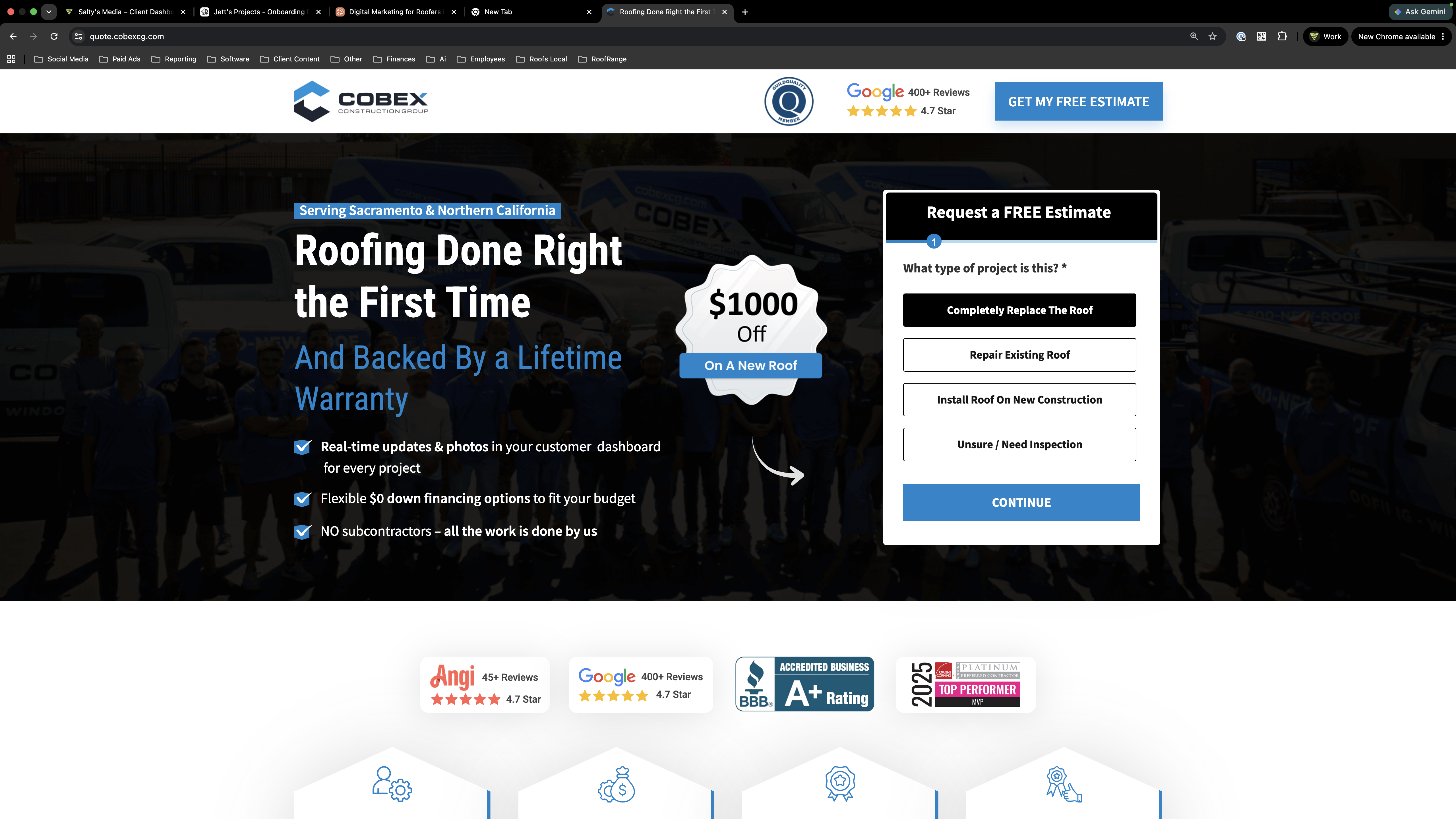
Cobex Construction Group · Sacramento & Northern California
 1
2
3
4
5
6
1
2
3
4
5
6
Benefit-led headline
"Roofing Done Right the First Time" with a lifetime-warranty subhead — outcome and risk-reversal before a single scroll.
Primary CTA, top-right
"Get My Free Estimate" pinned where every visitor expects it, in high-contrast blue. Mobile dialer-ready.
Review trust strip in the masthead
Google 400+ reviews at 4.7★ sit beside the logo — a real count, not naked stars.
Real crew & branded fleet
The actual team in front of wrapped trucks. Stock photos read as a red flag in 2026; this reads as proof.
One concrete offer
$1,000 off a new roof — a single, specific incentive badged at eye level instead of a vague "call for discounts."
Above-fold qualification form
Four project-type options, one tap, then a multi-step. Pre-qualifies serious buyers before a rep ever calls.
Should roofers run branded, non-branded, or Performance Max first?
Start with branded search even though bidding on your own name feels like paying twice. Your competitors are already bidding on it, and if you cede that ground you pay a premium to win back traffic that was yours. Non-branded search is where you capture new high-intent demand, so it carries the bulk of the budget and a higher cost to match. Performance Max comes third, once you're feeding the algorithm 30 or more clean conversions a month; run it sooner and it optimizes toward cheap form fills instead of booked jobs.
Run Local Service Ads alongside Search rather than instead of it. LSAs are the easiest Google product for a small operator, you only pay for qualified leads, and the Google Guaranteed badge earns trust before the click.
High-intent keywords worth bidding on:
- roof repair near me
- roof leak repair
- emergency roof repair
- roof replacement cost
- roofing company near me
- storm damage roof repair
Social and awareness: Meta, Nextdoor, retargeting, video.
Plenty of roofers wrote off Meta in 2024 and 2025 because the leads “got worse.” The leads didn't change. Meta CPMs climbed roughly 20% year over year, so the same budget reached fewer people — and the people it reached were more cautious. The roofers winning on Meta in 2026 do three things differently:
- They lead with a low-commitment offer — an inspection rather than a quote. Google catches the homeowner who already knows they have a problem; Meta catches the one who hasn't gotten there yet.
- They avoid ads that attract tire-kickers hunting for the cheapest roofer in town.
- They use multi-step forms that qualify the lead before anyone on the team picks up the phone.
Retargeting earns its keep here. With a 60-day decision window now normal, the visitor who didn't fill out a form on the first visit is still in market three weeks later. Remarket to them with proof — a finished job, a real crew, a financing offer. Building a recognizable brand is what makes all of it stick.
Foundational free tactics: GBP, local SEO, reviews.
Before any paid channel, the unpaid foundation has to be solid — because every ad you run sends a homeowner to check it. Work this checklist:
- Set your Google Business Profile primary category to “Roofing Contractor,” then add only the secondary categories you actually service. Google catches keyword stuffing.
- Upload geo-tagged job photos weekly, sorted into service-named albums (roof repair, completed projects, water damage). Real, dated, on-site photos beat polished stock in the local algorithm.
- Get to 100+ Google reviews by asking at the moment of payment, with a QR code that opens your review form. Respond to every single one.
- Build a real page for each priority city, 600–900 words with the city in the H1, local landmarks named, and an embedded map. Five strong city pages beat 40 thin ones.
- Keep your name, address, and phone identical everywhere (Yelp, BBB, Angi, Nextdoor). “Smith Roofing LLC” and “Smith Roofing” read as two separate businesses to Google.
The fourth listing might as well not exist.
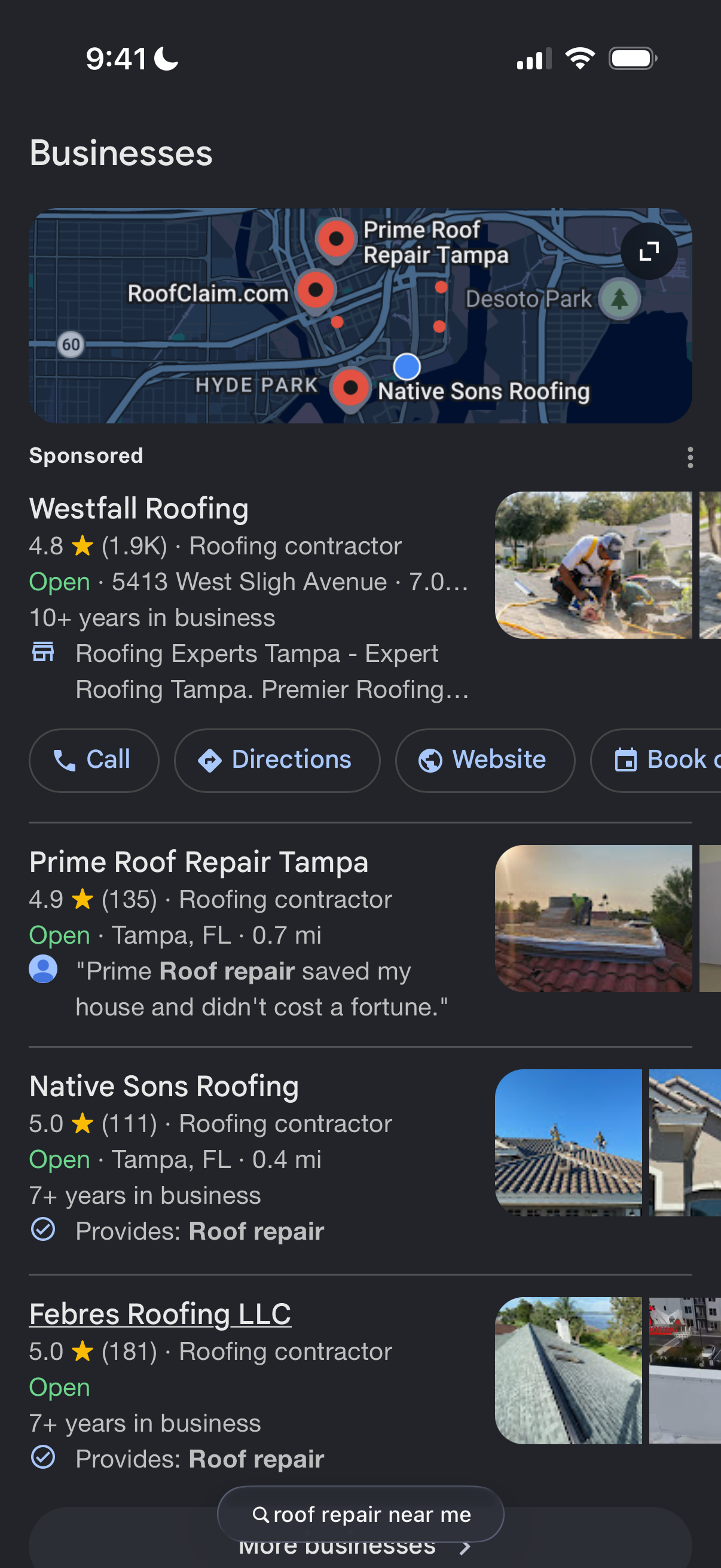
Roofer A
Roofer B
Roofer C
Roofer D
Same query, identical service area. The bottom listing pulls ~10% of P1's clicks — and the gap widens once the user opens a second tab to compare. Three companies make the pack. The fourth doesn't exist.
What the local algorithm actually rewards
The local pack rewards proof you actually work the neighborhoods you claim. Weekly photo cadence is what separates the top three listings from the ones nobody scrolls to see.
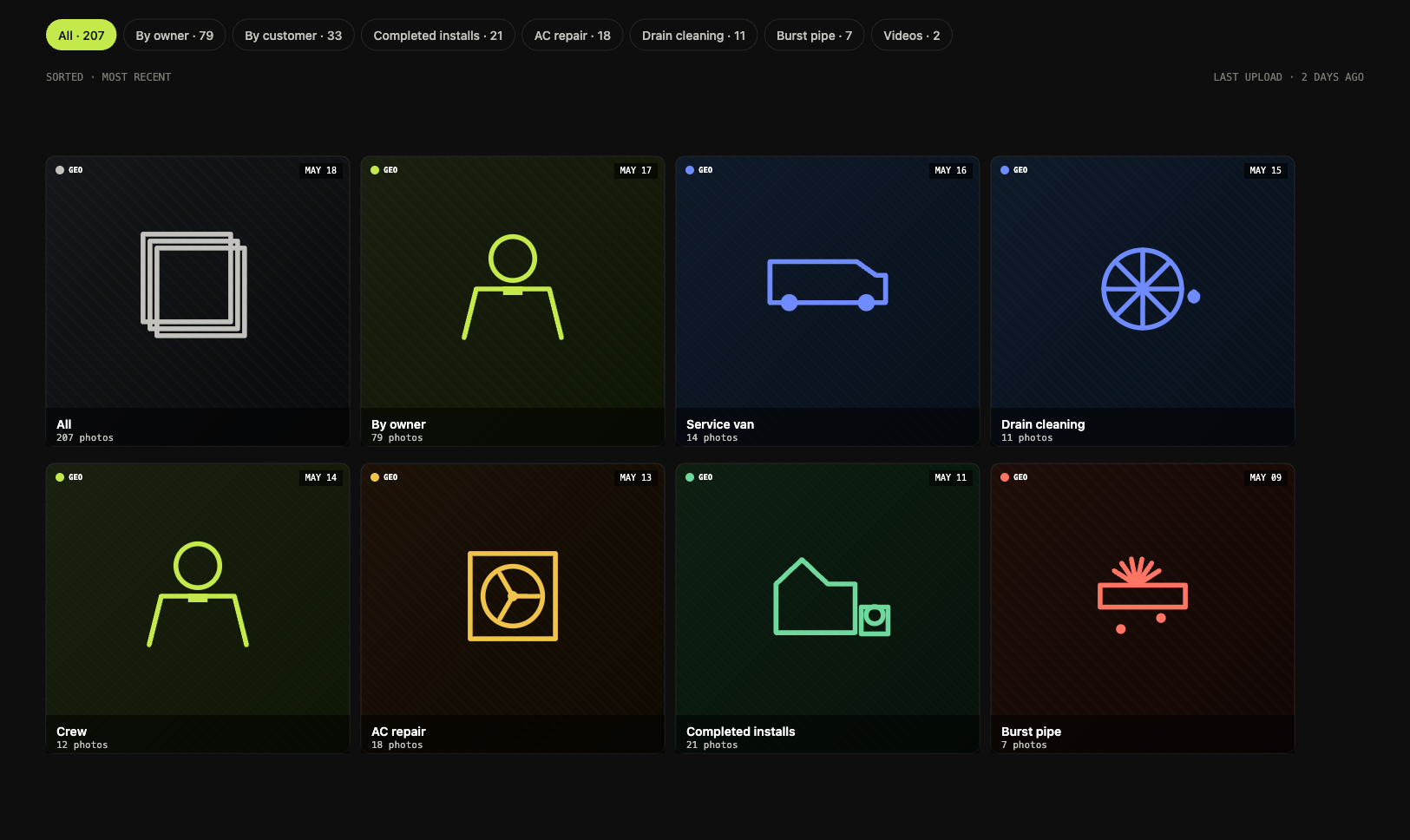
What the local algorithm actually sees.
 1
2
3
4
5
1
2
3
4
5
112 photos in the well · "All"
The volume that does the compounding. Above the local-pack threshold by 4×.
79 owner-uploaded · "By owner"
70% of the gallery is staff-driven — the cadence signal Google reads as "actively in business."
Service-named buckets · "Roof repair 15"
Generic albums lose. Each category becomes its own ranking surface for that service.
Outcome proof · "Completed projects 21"
Finished-work shots do the trust work on every comparison tab the homeowner opens.
Niche emergency category · "Water damage 7"
Captures urgent, high-intent searches your competitors can't service. Small bucket, high ROI.
The kind of geo-tagged, on-site cadence the local algorithm rewards. Real, dated photos beat polished marketing shots because they're proof you actually worked in the neighborhood.
Offers that close in a soft market: financing and monthly payments.
The homeowner who would have approved a $15,000 roof on the spot a few years back now wants to think about it. The number on the proposal is the problem. A $15,000 total reads as a major decision; “$249 a month with no money down” reads as something manageable. Both describe the same job. One is far more likely to get signed.
One number sells. The other one shops.
2,400 sq ft · GAF Timberline HDZ · tear-off + replace
Monthly payment in larger type than the total. Cheap change, real lift — and the gap between roofers who do it and roofers who don't is wider than any ad-spend optimization will ever close.
This is the largest unforced error in roofing right now. Around 73% of homeowners say they'd consider financing part of a project, and only about 38% of roofers offer it. The roofers who close that gap typically see close rates climb 30% to 50% within a quarter.
Treat the dealer fee as a marketing cost, not a loss. A 6–9% fee on a financed job feels like margin walking out the door until you compare it to your cost per lead. You already paid to acquire the homeowner; the fee is what converts the ones who would have walked, and the close-rate lift covers it several times over. Price it into the job rather than absorbing it. And run two providers — a prime-credit lender for the 700-plus FICO homeowner and a near-prime option for everyone else.
| Provider | Typical dealer fee | Credit floor | Best for |
|---|---|---|---|
| GreenSky | ~6–9% | ~640 | Volume operators, deferred-interest plans |
| Synchrony | Varies | ~640 | High-ticket replacements |
| Service Finance | ~5–8% | ~620 | Mixed credit tiers |
| Hearth | Free for contractors | ~580 | Small operators, fast onboarding |
| Enhancify | Free for contractors | ~580 | Lower-credit applicants |
Then train every salesperson to say the monthly payment first and the total second.
Traditional tactics that still work.
Digital gets the attention, but the offline plays still pull their weight — especially in a market where standing out matters more than ever. None of these replace your digital foundation. They compound it, putting your name in front of the same neighborhood from three directions at once.
Targeted direct mail
Skip the blanket blast. Mail the neighborhoods where you just finished a job — “we just replaced a roof two streets over” — or homes in an age bracket where roofs are due. A specific, local hook beats a glossy postcard with a generic discount.
Door-knocking the block
After storms and around completed jobs, a crew already on a street is your most affordable canvassing. Knock the neighbors while the truck and the dumpster are still there as proof you do the work.
Truck wraps as billboards
A clean wrap with your phone number and one clear offer earns impressions every time the crew drives to a job. Put the URL on the side — it's the cheapest reach you'll ever buy.
A yard sign on every job
Free, local, and trusted. A sign in a yard the neighbors recognize does quiet referral work for weeks after you've packed up and left.
Maintaining your share of voice in a downturn.
When demand softens, the instinct is to cut the ad budget and wait it out. That instinct is how roofers lose ground they spent years gaining. A century of marketing research — from Binet & Field's IPA work to Nielsen and the Ehrenberg-Bass Institute — points the same direction: brands that hold their share of voice through a soft market capture disproportionate share when demand returns, while brands that go dark lose it.
The cost of going dark
Ehrenberg-Bass puts the price of pulling your advertising at roughly 16% of sales after one year — and 25% after two. The math is friendlier than it looks: when competitors pull back, the auction thins and your spend buys more visibility per dollar. You don't have to outspend anyone. You have to be the roofer still showing up in the map pack and the search results when a cautious homeowner finally decides to act.
Questions roofers actually ask.
How do I advertise my roofing business in 2026?
Are Google Ads worth it for roofers?
Does Facebook advertising work for roofers?
What's a good cost per lead for roofing?
How fast should I respond to a roofing lead?
Why are my roofing leads getting worse?
You don't need every idea. You need the right few, in order.
Fix speed-to-lead first, because it costs almost nothing and rescues leads you're already paying for. Get your Google Business Profile and reviews working, since they make every ad dollar convert harder. Then put financing in front of homeowners and lead with the monthly payment. Paid search and Meta come next, built around repair-first offers instead of replacement quotes.
The roofers who hold their ground in 2026 are the ones who answer faster, offer financing, and stay visible while competitors go quiet.