Digital marketing for roofers in 2026:
the operator's playbook for a soft market.
The 2022 playbook ran on storms. The 2026 one has to run on speed, financing, and an honest CRM. Here's the system the roofers still hitting their numbers are actually using — and the places most accounts are silently leaking money.

Why digital marketing for roofers looks different in 2026.
If your cost per lead crept up in 2025 and your close rate dropped at the same time, you aren't running your campaigns wrong. The category got harder, and most of what's eating your numbers is happening outside your ad account.
The 2025 hurricane season finished with zero continental U.S. landfalls — the first time since 2015. For Florida, the Carolinas, and the Gulf, that's a chunk of insurance-funded replacement work that simply didn't happen. Owens Corning, the biggest U.S. shingle manufacturer, reported Q4 2025 roofing revenue down 27% year over year and guided another 20% drop in shingle volumes for Q1 2026.
The homeowner side didn't help. Mortgage rates sit at 6.30%, HELOCs at 7.10–7.24%, and the personal saving rate has dropped to 3.6% of disposable income. The Conference Board Expectations Index has been under the 80-point recession line for 15 months straight. The homeowner who would have green-lit a $24,000 roof in 2022 because their neighbor just got one done now wants three quotes and 60 days to think it over.
The ad platforms aren't doing you any favors either. Meta CPMs are up roughly 20% year over year. Google Ads CPLs in roofing now average $124 on non-branded search and $64 on Performance Max (SearchLight, Q1 2026).
None of this means digital marketing stopped working for roofers. It means the 2022 version of it stopped working. The 2026 version has to do four things the old playbook didn't have to.
Find leads inside a smaller demand pool.
Close the gap between form-fill and phone call.
Put financing in front of homeowners who can't write a check.
Stay in front of buyers across a longer decision window.
What counts as digital marketing for a roofing company.
Digital marketing for a roofing company is the set of online channels that turn attention into booked appointments. Six surfaces matter; the rest is noise.
Website
Where the homeowner decides whether to call. Click-to-call, an honest pricing range, and financing visible without scrolling.
Google Business Profile
Where most 2026 homeowners meet you first. A half-filled GBP loses to a competitor with weekly photos and 200+ reviews every time.
Google Search · LSAs · PMax
The high-intent buyer typing "roof repair near me" at 6am after they spotted a stain on the ceiling.
Meta — FB, IG, Reels
Awareness, repair-first offers, and remarketing the visitors who didn't fill out a form on the first visit.
Reviews
The workhorse showing up inside your GBP, your ads, and every comparison the homeowner makes before they call.
Email & SMS automation
The 9pm Friday form-fill that doesn't sit in an inbox until Monday — by which point they've already talked to two competitors.
The roofing website foundation.
Traffic always helps. Without a site built for conversion, you're burning money — paying $124 to land a stranger on a page that can't do its job in the eight seconds the homeowner gives it.
A roofing website that converts in 2026 is a sales tool that has to work on a phone, while the homeowner is standing in the driveway looking up at a missing shingle.
Six elements of a landing page that converts
-
A headline tied to your UVP
What sets you apart in your market? Start there. Generic "We do roofs" never beat a specific promise.
-
Phone number top-right, clickable on mobile
Plus a short form above the fold. Both, not either.
-
A trust strip with real logos and badges
GAF, Owens Corning, CertainTeed, BBB. Real review counts and ratings — not stars without numbers.
-
Three to five real photos of your crew on real jobs
Stock photos of pristine roofs read as a red flag in 2026. Dated, dusty, and on-site beats polished every time.
-
Reviews pulled in live from Google
Not screenshots that could be five years old. Live widget or nothing.
-
Conversion-optimized design
Every element earns its place. Remove anything that doesn't push a tap toward call, form, or estimate.
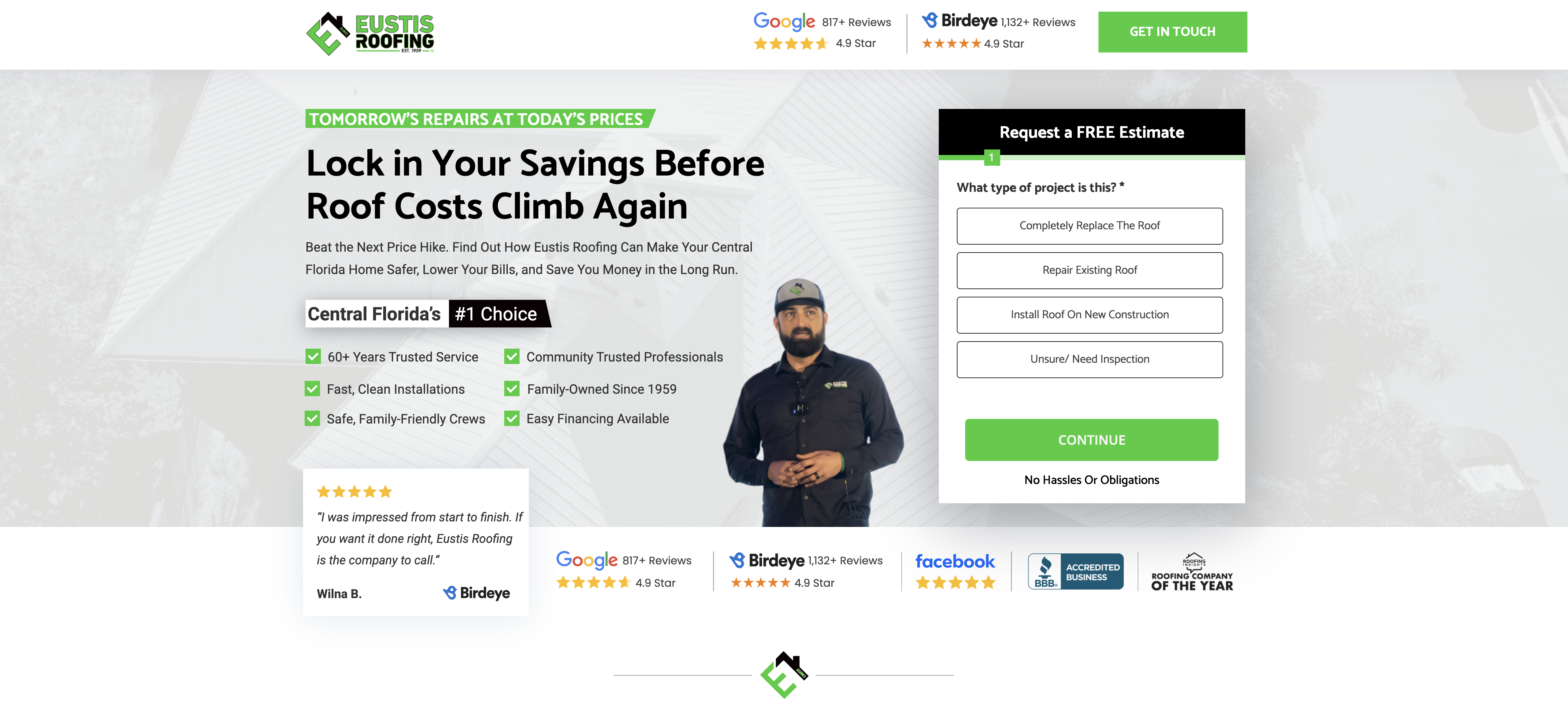
Eustis Roofing · 60+ years, Central Florida, family-owned
 1
2
3
4
5
6
1
2
3
4
5
6
UVP-led headline
"Lock in Your Savings Before Roof Costs Climb Again" — specific, urgent, financing-flavored.
Click-to-call top-right
"Get In Touch" pinned where every roofing visitor expects to tap. Mobile dialer-ready.
Real review trust strip
Google 817+ and Birdeye 1,132+ counts in the masthead, not stars without numbers.
Real crew, no stock
The owner on-camera. Pristine stock photos read as a red flag in 2026.
Live reviews, not screenshots
Birdeye-pulled testimonial rotating in. Always current, never five years stale.
Above-fold qualification form
Four project-type options, one tap, then the multi-step. Pre-qualifies serious buyers.
The fixes are unglamorous: compress your hero image under 200KB, lazy-load anything below the fold, kill the autoplaying video, and stop using a 12-script chat widget that loads before your phone number does. Run your page through PageSpeed Insights once a quarter and fix anything in the red.
Instant estimators, financing widgets, click-to-call
Three on-page tools are doing the heavy lifting in 2026:
- Instant estimators (Roofle, Roofer.com, Roofr) — the homeowner gets a price band before they talk to anyone. Weeds out the tire-kickers and pre-qualifies the serious ones.
- Financing widgets (GreenSky, Hearth, Service Finance, Enhancify) that surface "as low as $189/month" on the page. With 73% of homeowners willing to consider financing and HELOC rates over 7%, monthly payments are how the deal gets done.
- Click-to-call buttons that trigger the dialer on iOS and Android. Around 50% of roofing leads still come in by phone. If your number isn't tappable, you're losing half your conversion before it starts.
How roofers win the map pack.
When a homeowner searches "roof repair near me," the map pack shows up before the organic blue links. Three companies get visible. The fourth might as well not exist. For most residential roofers, ranking in the top three of the local pack is worth more than ranking #1 organically.
The good news: the local pack is winnable on a smaller marketing budget than paid search. The bad news: the bar has moved. The contractors winning in 2026 are treating GBP like a second website.
The fourth listing might as well not exist.
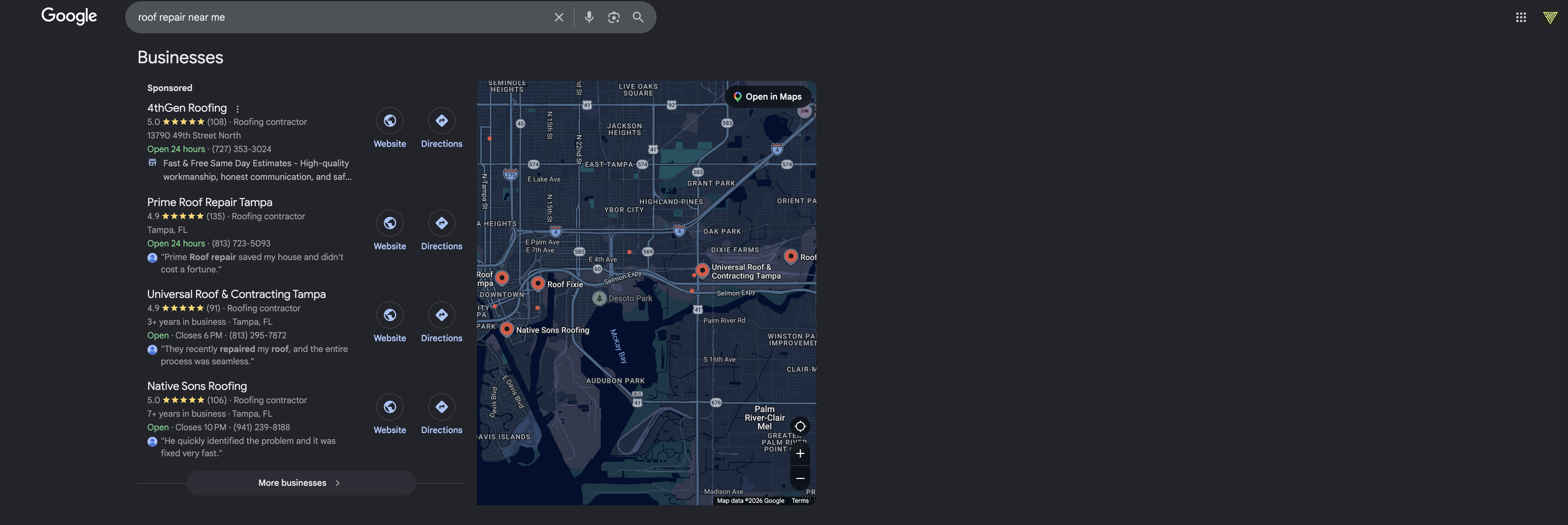
4thGen Roofing
Prime Roof Repair Tampa
Universal Roof & Contracting
Native Sons Roofing
Same query, identical service area. The bottom listing pulls ~10% of P1's clicks — and the gap widens once the user opens a second tab to compare. Three companies make the pack. The fourth doesn't exist.
Optimizing GBP categories, services, and photos
Set your primary category as "Roofing Contractor." Add secondary categories that match what you actually do — "Roofing Supply Store" if you sell, "Gutter Cleaning Service" if you clean. Don't stuff categories you don't service. Google catches it.
Inside the Services section, add every service you offer with a short, specific description. Generic "roof repair" loses to "asphalt shingle repair, flashing replacement, ridge cap repair, emergency tarping." Same for Q&A — pre-populate it or your competitors will.
Photos matter more than most contractors think. GBP listings with weekly photo uploads outperform listings that haven't added one since 2022 by a wide margin. Geo-tag at the job site using DataPins or RoofSnap. Before-and-after pairs. Crew. Truck. Dumpster. Real, dated, geo-stamped photos beat polished marketing shots in the local algorithm because they're proof you actually work in the area.
What the local algorithm actually sees.
 1
2
3
4
5
1
2
3
4
5
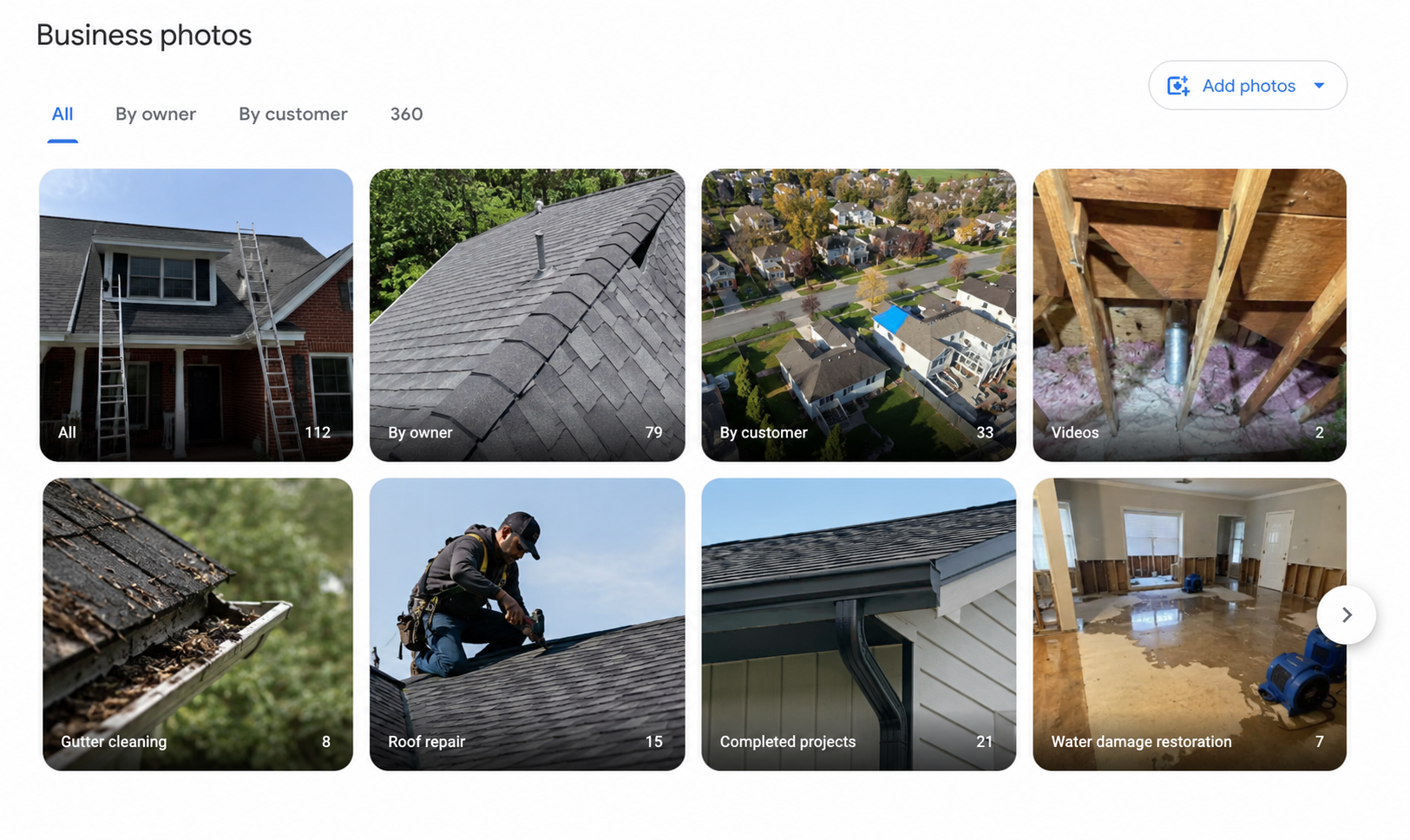
112 photos in the well · "All"
The volume that does the compounding. Above the local-pack threshold by 4×.
79 owner-uploaded · "By owner"
70% of the gallery is staff-driven — the cadence signal Google reads as "actively in business."
Service-named buckets · "Roof repair 15"
Generic albums lose. Each category becomes its own ranking surface for that service.
Outcome proof · "Completed projects 21"
Finished-work shots do the trust work on every comparison tab the homeowner opens.
Niche emergency category · "Water damage 7"
Captures urgent, high-intent searches your competitors can't service. Small bucket, high ROI.
The kind of geo-tagged, on-site cadence the local algorithm rewards. Real, dated photos beat polished marketing shots because they're proof you actually worked in the neighborhood.
Service-area pages and city-level content
A single "Service Area" page listing 40 cities doesn't rank for any of them. Build a real page for each priority city: 600–900 words, city name in the H1, local landmarks named in the body, an embedded Google map of that city, photos of work done there, reviews from customers in that ZIP if you have them.
Five well-built city pages beat 40 thin ones. Start with the cities where your closest competitor is weakest, not where your office happens to sit.
Citations, NAP consistency, geo-tagged photos
Citations (your Name / Address / Phone on Yelp, BBB, Angi, HomeAdvisor, Nextdoor, Houzz, BuildZoom) are still a ranking factor. The exact wording matters. "Smith Roofing LLC" and "Smith Roofing" are read as two different businesses. Pick one and use it everywhere.
Run a citation audit annually with Whitespark, BrightLocal, or Moz Local. Fix mismatches and kill duplicates. Geo-tagged weekly photos give Google a steady drip of proof you're working the neighborhoods you claim. Most contractors do it once at onboarding and never again — which is exactly why the ones who do it weekly outrank them.
Google Ads, LSAs, Performance Max — what's actually working.
Google Ads is the single highest-intent paid channel a roofer can run. Someone typing "roof leak repair" into Google at 7am is closer to writing a check than someone scrolling Facebook. The auction has gotten more expensive since 2022, and the gap between roofers who run Google well and roofers who burn money on it has widened.
2026 cost-per-lead benchmarks
Roofing-vertical averages across active accounts
CPL alone is the wrong metric. A $300 lead from a 7-step qualification form will outperform three $100 leads from a "name and email" form — every time.
The roofing accounts we manage at Salty's run anywhere from $100 to $350+ per lead depending on qualification depth, market, and offer — and the higher-CPL accounts often deliver the strongest ROI. The number that matters is return on ad spend, not the headline CPL.
Branded search is the cheapest and most profitable inventory you'll ever buy, and most roofers underspend on it because it feels like cheating. It isn't. Your competitors are bidding on your brand name. If you're not, you're paying a 3× premium to win back traffic that was already yours.
LSAs vs. Search Ads vs. PMax — when to use each
| Local Service Ads | Search Ads | Performance Max | |
|---|---|---|---|
| Cost model | Per qualified lead | Per click | Per conversion |
| Intent | High calls + booked appts | High active searchers | Mixed |
| Best for | Repair, emergency, residential leads | Replacement, repair, branded | Scaling once you have conversion data |
| Quality control | High disputable leads | Medium negatives needed | Low algorithm runs the show |
| Scalability | Capped by zip demand | High | Highest |
| Setup difficulty | Low | Medium | Med–High |
LSAs are the easiest Google product for a small roofer to run, and Google Guaranteed certification is worth chasing — it puts a green badge on your listing. Run LSAs alongside regular Search, not instead of it. PMax should come third, once you've got 30+ conversions a month feeding the algorithm clean data.
The five reasons roofing PPC fails
The same handful of mistakes show up in nearly every roofing account we audit:
- Storm-chaser keywords ("hail damage roof," "insurance roof claim") with no geographic restriction, eating budget on out-of-state clicks.
- No negative keyword list, so the account spends on "roofing jobs hiring near me," "free roof," and "DIY roof repair."
- Smart Bidding optimizing toward Form Fills instead of qualified leads — training the algorithm to find the cheapest forms (read: the worst leads).
- Landing pages that send paid traffic to the homepage instead of a campaign-specific page.
- No call tracking, so half the conversions never get attributed and the bidding algorithm flies blind.
Fix those five and the same budget produces 30–60% more booked jobs. We've seen it on enough audits to call it a pattern.
Disputing LSA leads and protecting Quality Score
LSAs let you dispute leads that were spam, out of service area, or for a service you don't offer. Most roofers don't dispute anything. The ones who dispute consistently see their cost per qualified lead drop 15 to 25% over a quarter, because Google reads the disputes as a quality signal and routes better leads to listings that flag bad ones.
For Search, Quality Score is the multiplier on everything. A Quality Score of 8 pays roughly half what a Quality Score of 4 pays for the same position. Tight ad-group themes, ad copy that mirrors the search query, and landing pages with the keyword in the H1 — those are the three levers. Audit your account for any keyword scoring 5 or below, and either fix it or pause it.
Facebook and Instagram ads — when the offer is right.
A lot of roofers wrote off Meta in 2024 and 2025 because the leads "got worse." The leads didn't get worse. CPMs went up roughly 20%, the same budget reached fewer people, and the people it did reach were more cautious. For roofing companies, that means adjusting the strategy — not abandoning the channel.
Google catches the homeowner who already knows they have a problem. Meta catches the homeowner who hasn't gotten there yet.
The roofers thriving on Meta in 2026 share three things:
- They lead with a low-commitment offer (an inspection, not a quote).
- They treat brand awareness as a long-term play.
- They remarket aggressively.
If you're treating Meta like a channel where you bolt on the same "free quote" CTA you run on Google, you're paying 2026 CPMs to compete for 2022 buyers.
-
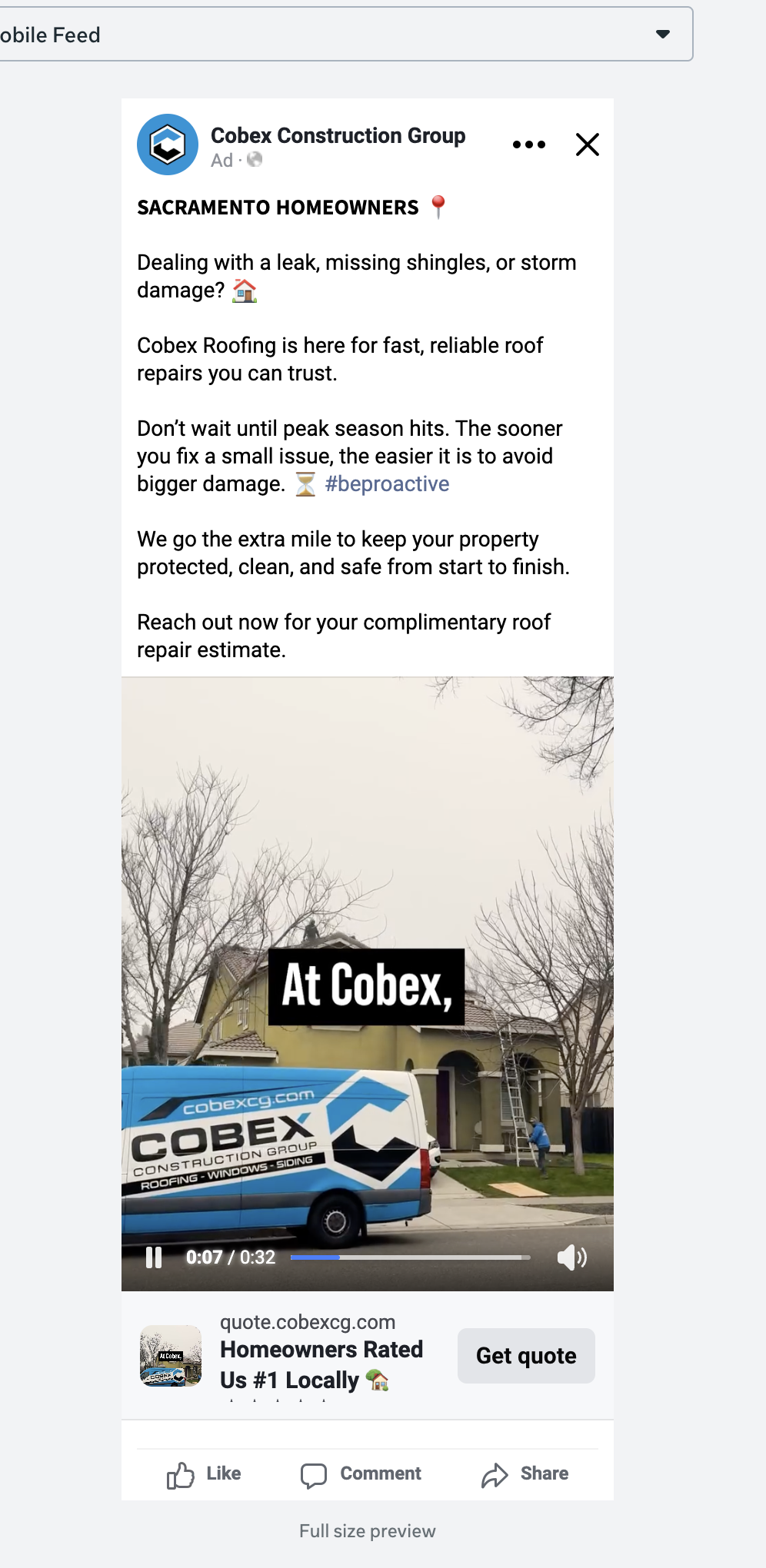
01
Geo-locked hook
SACRAMENTO HOMEOWNERS qualifies in the first line. Anyone outside the geo scrolls past — the click that doesn't fire was free to skip.
-
02
Repair-first, not replacement
leak, missing shingles, or storm damage meets the cautious 2026 buyer earlier in the journey. Replacement asks for a $24K decision; repair asks for a phone call.
-
03
Urgency without discount
Don't wait until peak season pulls timing without burning margin on a 20% off offer. Discounting a decision they haven't made doesn't move them.
-
04
Branded proof, in motion
Real crew on a real roof, branded van with the URL on the side. Static or motion both work — the angle is what matters.
-
05
Quote-flow CTA, not "Learn more"
Get quote → quote.cobexcg.com → multi-step form. Pre-qualifies before the sales call instead of dumping into a generic homepage.
Reviews, reputation, and the five-minute rule.
Two unpaid assets do more for roofing close rates than any single ad campaign — a healthy review profile and a follow-up system that catches every lead within five minutes. Do not write these off.
Why 4.8 stars and 100 reviews beats most paid budgets
The homeowner who clicks your Google ad doesn't go straight to your website. They open a second tab and check your reviews. If you're at 4.3 stars with 27 reviews and your competitor is at 4.8 with 230, you just paid for the click and sent the lead straight to your competitor.
The math is straightforward: a roofer at 4.8/100 converts paid traffic at meaningfully higher rates than a roofer at 4.3/30, on the same offer and the same landing page.
Get to 100 Google reviews. Ask every customer at the moment of payment, when they're happiest, with a tablet in hand and a QR code that goes straight to your GBP review form. Respond to every review — including negative ones — in a tone that reads like the owner wrote it. Don't run review-gating software. Google catches it, and homeowners have caught on too.
The speed-to-lead clock
The MIT / Oldroyd study is the most cited piece of research in lead gen — and most roofers still ignore it.
An after-hours plan that books appointments
A lot of roofing leads come in outside business hours — forms filled at 9pm Friday, 7am Saturday, lunch on Wednesday. If your sales team starts calling those at 8am Monday, you've lost two-thirds of them.
A workable after-hours stack:
- Auto-text within 60 seconds of any form submission. "Hi [name], this is Mike at [company]. Got your request. I'll call you within the hour. If urgent, text me back here." A real cell number, a real name.
- Live answering service for inbound phone calls (Smith.ai, Ruby, Nexa). They answer 24/7 in your company name, capture the lead, and book appointments to your calendar.
- AI receptionist (Roofr's AI receptionist, Goodcall, Numa) for high-volume operators who want full call answering without per-minute service costs.
- A 9am Monday callback rule for everything that came in over the weekend, with the answering service or auto-text holding the lead together until the human follows up.
The 9:43 PM Friday form-fill that doesn't sleep.
Hi Sarah, this is Mike at Coastal Roofing.
Got your request about the missing shingles on Magnolia. I'll call you within the hour. If urgent, text me back here.
yes urgent — water is coming through the ceiling in the back bedroom. tomorrow morning ok?
Booked you for Saturday 10am. Calendar invite sent to sarah@…
I'll bring tarps in case it rains overnight — we'll cover the roof first thing.
Form submitted
Sarah, Tampa. Missing shingles + active ceiling leak, single-story.
Auto-text fires
Real cell, real name. CRM-triggered. Industry average to first contact: 47 hours.
Homeowner replies
Confirms urgency. Two competitors haven't responded yet.
Saturday 10 AM on the calendar
Total time from form to confirmed appointment: 4 minutes.
A real cell number, a real name, and a 60-second SLA. The single highest-ROI automation in roofing — and the reason the 9 PM Friday form-fill doesn't end up in Monday's voicemail.
Offer engineering for a soft market.
The same homeowner who would have green-lit a $24,000 replacement on impulse in 2022 wants three quotes and 60 days in 2026. You can fight that with bigger ad budgets, or you can engineer offers that meet the buyer where they actually are.
Discounting a decision the homeowner hasn't made yet doesn't move them. A free inspection moves them, because it converts the worry into a calendar event.
Maintenance plans and recurring revenue
A roofing maintenance plan ($199–$399/year for an annual inspection, debris cleanup, minor repairs, and a multi-year warranty extension) does two things. It generates recurring revenue from homeowners who weren't ready to replace, and it creates a list of customers you can market to when they finally are.
The math is good. A roofer with 400 maintenance customers paying $299/year is generating $120,000 in nearly-passive revenue and owns the relationship the next time those roofs need replacing.
Financing partners — fees, credit floors, dealer math
73% of homeowners say they'd consider financing part of a project. Roughly 38% of roofers offer it. That's the largest unforced error in the industry right now.
| Provider | Typical dealer fee | Credit floor | Best for |
|---|---|---|---|
| GreenSky | ~6–9% promo plans | ~640 FICO | Volume operators, deferred-interest plans |
| Service Finance | ~5–8% | ~620 FICO | Mid-size operators, mixed credit tiers |
| Hearth | Free for contractors | ~580 FICO | Small operators, fast onboarding |
| Synchrony (HOME) | varies | ~640 FICO | High-ticket replacements, deferred interest |
| Enhancify | Free for contractors | ~580 FICO | Multi-lender shopping, lower-credit applicants |
Run two providers, not one. A prime-credit lender (GreenSky, Synchrony) for the 700+ FICO homeowner, and a near-prime option (Hearth, Enhancify) for everyone else. The dealer fee is real — price it into your job, don't absorb it — but the close-rate lift covers it. Roofers who add financing typically see close rates jump 30–50% within the first quarter.
One number sells. The other one shops.
2,400 sq ft · GAF Timberline HDZ · tear-off + replace
Monthly payment in larger type than the total. Cheap change, real lift — and the gap between roofers who do it and roofers who don't is wider than any ad-spend optimization will ever close.
Scaling the business from marketing to ops.
A lot of roofers hit a ceiling around $1M to $1.5M and assume the answer is more leads. Usually it isn't. The leads are coming in — they're not getting answered, tracked, or followed up on, because the operational plumbing wasn't built for the volume the marketing is driving. You can't outspend a broken intake.
Stage-based growth — $0–$1M, $1–$3M, $3M+
The marketing playbook isn't the same at every stage. What works at $400K of revenue might break at $3M.
$0 – $1M
What works
- GBP & reviews
- Referrals
- $500–$2,000/mo Google Search or LSAs
What's a distraction
- Brand video
- Billboards
- Performance Max
$1M – $3M
What works
- All Stage 01, plus Meta
- Paid SEO & CRM
- Financing & speed-to-lead
What's a distraction
- Aggressive new-market expansion before ops is dialed
$3M+
What works
- Brand-building — CTV, YouTube pre-roll
- Performance Max
- Multi-market expansion, in-house marketing hire
What's a distraction
- DIY tactics
- Bootstrapped tools
The roofers we've watched go from $1M to $5M didn't out-spend the ones stuck at $1M. They out-answered them.
Marketing budget by stage
Healthy marketing spend
As a % of revenue, across residential roofers Salty's audits
Where the money goes
Typical Stage 02 ($1–$3M) mix
KPIs — measuring the right things.
Most roofing dashboards measure the wrong things. Impressions, clicks, and form fills tell you the campaign is alive. They don't tell you whether it's making money.
A $40 lead that never books costs you more than a $200 lead that closes. Cost per booked appointment is the real number. Push every form fill and phone call into your CRM with a campaign source attached, and tag the ones that actually got on the calendar.
The funnel — where the leak usually is
Lead → Appointment
Appointment → Bid (sit)
Bid → Close
ROAS, LTV, and attribution
Track ROAS per channel, not in aggregate. A $40,000/month spend at a 4× blended ROAS hides that LSAs are running at 8× and Performance Max is at 1.5×. Rebalance accordingly.
Lifetime value matters more in roofing than most contractors realize. A residential customer who buys a roof, signs up for maintenance, and refers two neighbors is worth $40,000–$60,000 over a decade — not $18,000 on a single job. Bid your ad spend against LTV, not first-job revenue.
Half of roofing leads still come in by phone. If you don't have call tracking (CallRail, WhatConverts, CallTrackingMetrics), you don't know what's working. Pair call tracking with GCLID capture and offline conversion uploads. Smart Bidding optimizes toward whatever you feed it. Feed it real revenue and it finds bigger jobs.
How to choose a roofing marketing agency.
A lot of contractors hire an agency on a referral and a 30-minute call, then spend the next six months trying to figure out what they're paying for. A short list of questions up front saves the headache:
- How many roofing or home-improvement clients do you currently work with?
- How do you define a qualified lead, and what metric do you optimize for?
- Can I see a search-term report or landing page from a current roofing client?
- What's the contract length, and what's the offboarding process?
The bigger filter is what you're paying for. Impressions, clicks, and form fills are easy to report and easy to inflate. Booked appointments and signed contracts are harder to fake.