Digital marketing for home services in 2026:
the operator's playbook.
The contractor still hitting numbers in 2026 isn't running one channel harder. They're running a five-layer stack — website, local SEO, paid, reviews, and AI search — where each layer holds up the one above it. Here's the system, the benchmarks, and the seven places almost every account is silently leaking money.

What digital marketing for home services actually means in 2026.
Digital marketing for home services is the system contractors use to fill their schedule with local, high-intent leads through search, paid ads, reviews, content, and now AI-search visibility. The definition has shifted hard in the last 18 months, and most contractors are still running a 2022 playbook in a 2026 market.
A homeowner standing in two inches of water on the kitchen floor doesn't read three blog posts and subscribe to a newsletter. She grabs her phone, types "emergency plumber near me," and hires whoever picks up first. Most of these decisions happen on mobile, within a couple of hours, inside a five-mile radius. Trust gets built in the time it takes a Google Business Profile to load and an eye to scan a star rating.
That mobile-first, near-me-first reality reorders the marketing stack. Channels that work for SaaS or e-commerce — long nurture funnels, content-led demand-gen, paid social as the front door — underperform here. The channels that win are the ones already in front of a homeowner with intent: Google Search, the Map Pack, Local Services Ads, reviews, and now ChatGPT and Perplexity. The rest are amplifiers, not engines.
The four buyer types and how each one searches
Not every lead behaves the same way. Four buyer types show up in a home services funnel, in rough order of urgency. A stack that wins all four looks pretty different from one built to win just emergencies, or just projects.
Emergency. Burst pipe, no heat, storm damage. Searches "near me," calls the first three results, hires inside the hour.
Urgent-but-flexible. Slow drain, AC running loud, a couple of missing shingles. Compares two or three on reviews and response speed over a day or two.
Project. Full reroof, kitchen remodel, new HVAC. Gets three to five bids over 30–90 days, weighs financing, reads the content on the site.
Recurring. Pest control, lawn care, cleaning. Buys once on trust signals and stays for years if you don't give them a reason to leave.
Show up first in the channels your buyer is already using. Look trustworthy when they land. Answer the phone inside five minutes. Every tactic in the rest of this article exists to serve one of those three jobs.
The Salty's home services marketing stack.
Contractors who consistently fill their schedule treat marketing like a stack, where each layer holds up the one above it. Skip a layer and the whole thing wobbles. The order matters — contractors who try to build Layer 5 on top of a broken Layer 1 burn money fast. Foundation first, then build up.
“Contractors come to us paying for Google Ads, running them on a website that doesn't convert and a CRM that doesn't track the calls. We fix the foundation first. The same ad spend works better the next month — and we haven't touched the ad spend.”
— Jett Collins · Co-founder, Salty's Media
Website, tracking, Google Business Profile.
The boring bottom layer that decides whether anything above it pays off. A fast mobile site with click-to-call above the fold. Call and conversion tracking wired into GA4 and the CRM so every lead has a source. A GBP that's actually complete, with the right primary category, real photos, and accurate service areas.
Local SEO, LSAs, Google Ads.
Catches the homeowner who already knows what they need. Local SEO and Map Pack visibility for "[trade] near me." Local Services Ads with the new Google Verified badge (consolidated from Google Guaranteed in October 2025). Search Ads for the keywords LSAs and organic don't cover.
Reviews, video, named expertise.
Showing up first only matters if the homeowner picks you. A review engine pulling multiple new reviews each week through SMS and post-job automation. Short video on the GBP, the homepage, and YouTube. Named expertise on the site — owner bio, certifications, faces of the actual team.
Content, social, email, referrals.
Layers 1–3 harvest demand that already exists. Layer 4 makes more of it. Content built around the questions homeowners actually type into Google — pricing, seasonal headaches, repair-or-replace decisions. Facebook and Instagram for visual trades. Nextdoor for neighborhood-level trust. Email and SMS for keeping past customers in the rotation.
GEO, schema, entity SEO, community signals.
The newest layer, and the one almost nobody has built yet. Schema markup (LocalBusiness, FAQPage, HowTo) so AI tools can extract your answers cleanly. Author bios with sameAs links so Google and ChatGPT recognize who's behind the content. A real presence in the places ChatGPT, Perplexity, and Google AI Overviews pull from — Reddit, YouTube, trade media, and credentialed blogs.
Your website is your 24/7 closer.
No amount of ad budget and campaign adjustments can fix a poor experience on your website or landing page. If a homeowner can't find a phone number, read a price range, or believe the photos are real, you've already lost the click — and the click cost you money.
A home services site that converts in 2026 is a sales tool that has to work on a phone, while the homeowner is standing in the driveway looking at the leak or in the kitchen watching the AC blow warm air.
The 3-second test
If your page hasn't loaded and shown a phone number in three seconds on a mid-range Android over LTE, you've lost a chunk of your traffic before they ever saw your offer. Google's Core Web Vitals are the cleanest scorecard:
- LCP under 2.5 seconds. The hero image and headline have to be on screen.
- INP under 200 milliseconds. Taps feel instant, not laggy.
- CLS under 0.1. Nothing jumps around as the page renders.
Mobile-first isn't a design preference anymore. It's where 70–80% of home services traffic lives, and where Google decides what to rank.
Six elements of a landing page that converts
-
A headline tied to your UVP
What sets you apart in your market? Start there. "24/7 emergency plumbing, on-site in 60 minutes" beats "We do plumbing" every time.
-
Phone number top-right, clickable on mobile
Plus a short form above the fold. Both, not either. The homeowner with water on the floor wants a button, not a contact form.
-
A trust strip with real logos and badges
License number, insurance and bonding, manufacturer credentials (Lennox Premier, GAF Master Elite, Generac Elite). Real review counts — not stars without numbers.
-
Three to five real photos of your crew on real jobs
Stock photos of pristine technicians read as a red flag in 2026. Dated, dusty, and on-site beats polished every time.
-
Reviews pulled in live from Google
Not screenshots that could be five years old. Live widget or nothing.
-
Conversion-optimized design
Every element earns its place. Remove anything that doesn't push a tap toward call, form, or booking.
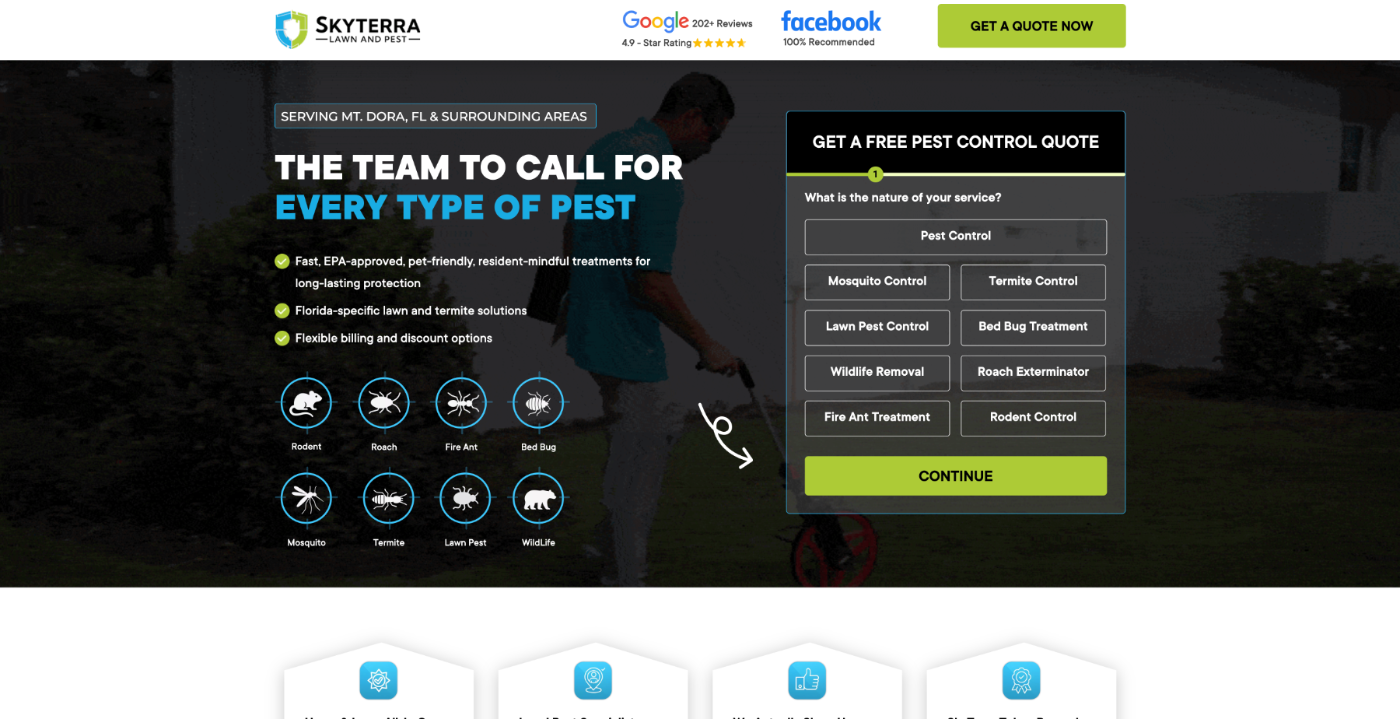
SkyTerra Lawn & Pest · pest control · Mt. Dora, FL & surrounding
 1
2
3
4
5
6
1
2
3
4
5
6
UVP-led headline
"The team to call for every type of pest" — specific, declarative, with an accent color pulling the eye to the buyer's job.
Persistent quote CTA, top-right
"GET A QUOTE NOW" in the brand-green accent. Pinned where every visitor expects to tap. Mobile dialer-ready.
Live trust strip in the masthead
Google 202+ reviews at 4.9★ plus Facebook 100% Recommended. Real counts in the trust spot, not stars without numbers.
Real tech on a real job
Owner-operator with the spreader, on a real lawn. Stock photos of pristine technicians read as a red flag in 2026.
Service-icon grid as visual proof
Eight pest categories visible at a glance. Cuts the homeowner's "do they handle bed bugs?" check from a click to a glance.
Above-fold qualification form
Service-type tap first, then the multi-step. Pre-qualifies the serious buyer and hands the call center a brief before the phone rings.
The fixes are unglamorous: compress your hero image under 200KB, lazy-load anything below the fold, kill the autoplaying video, and stop loading a 12-script chat widget before your phone number does. Run the page through PageSpeed Insights once a quarter and fix anything in the red.
Service-area and trade-specific landing pages
One homepage covering "we serve the greater Tampa area for roofing, plumbing, HVAC, and electrical" doesn't rank for any of those, in any of those towns. The pages that win the Map Pack and organic results are specific: a dedicated landing page for roof replacement in Brandon, another for AC repair in St. Pete, another for water heater install in Clearwater. Same logic for trade verticals — pest control, landscaping, garage doors, and cleaning each need their own page with their own H1, schema, and reviews.
Click-to-call, online booking, live chat, AI receptionists
The homeowner with water on the floor wants a button, not a contact form. Click-to-call above the fold, online booking for the urgent-but-flexible buyer, and a chat widget or AI receptionist (CallRail's Voice Assist, ServiceTitan's, Jobber's) for after-hours coverage.
Trust elements
License numbers visible in the footer. Insurance and bonding badges near the CTA. Real before-and-after photos (not stock), real reviews pulled live from Google with Review schema, and the owner's actual face on the About page. Homeowners hire people, not logos.
And don't outsource the copy to an AI tool churning out generic service pages — that approach blends in instead of standing out. The page needs a clear objective and information valuable enough to move a homeowner toward choosing you in their mind before they ever pick up the phone.
Local SEO and the Google Business Profile.
For home services, the Google Business Profile is the most valuable real estate on the internet. The Map Pack sits above the organic results, and the homeowner picking between three businesses is almost always picking from those three. Get the GBP right and a lot of the rest gets easier.
The good news: the Map Pack is winnable on a smaller marketing budget than paid search. The bad news: the bar has moved. The contractors winning in 2026 are treating GBP like a second website.
The fourth listing might as well not exist.
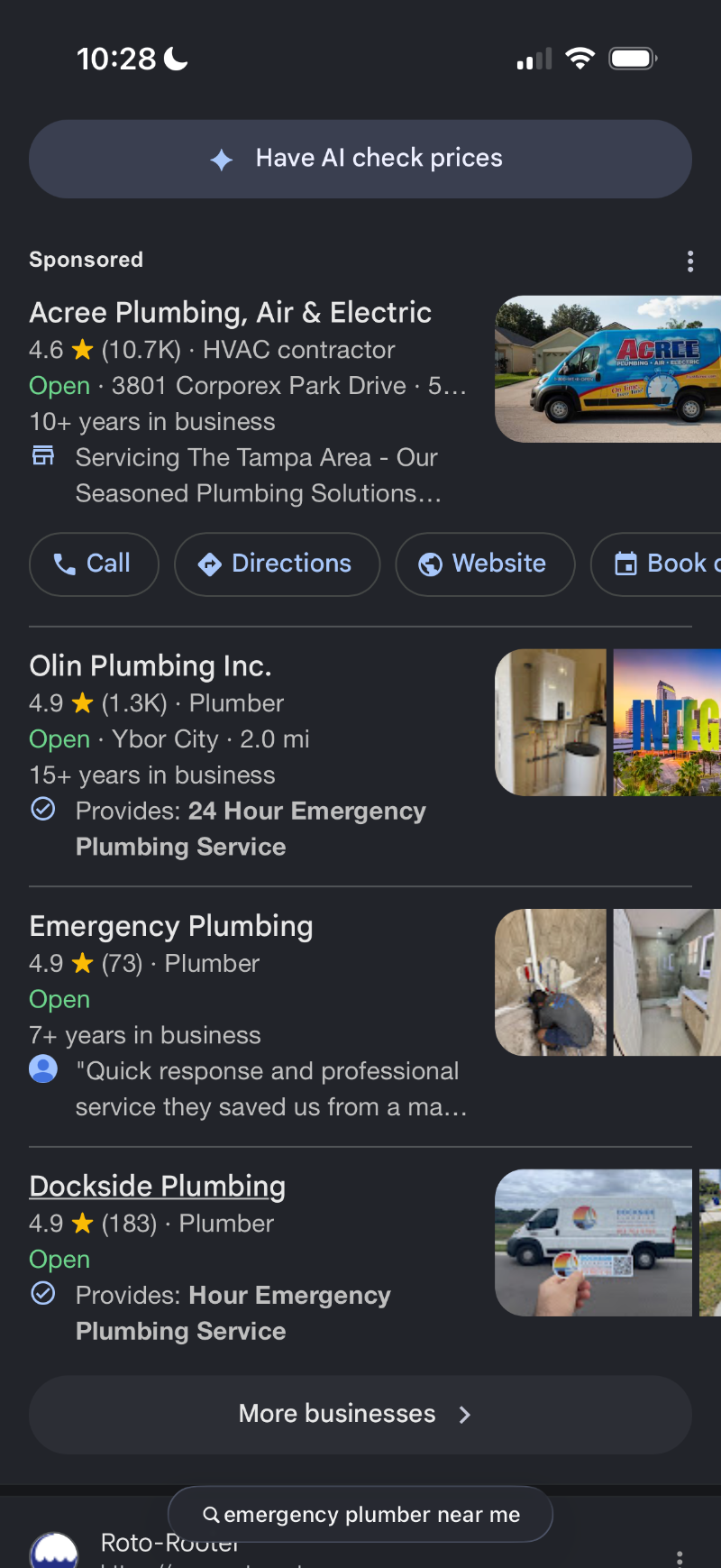
Acree Plumbing, Air & Electric
Olin Plumbing Inc.
Emergency Plumbing
Dockside Plumbing
Same query, identical service area. The bottom listing pulls ~10% of P1's clicks — and the gap widens once the user opens a second tab to compare. Three companies make the pack. The fourth doesn't exist.
The GBP checklist
Set the primary category as the most specific match for what you do: HVAC Contractor, Plumber, Roofing Contractor, Electrician, Pest Control Service, Landscaper, Garage Door Supplier, House Cleaning Service. Not generic ones like "Home Improvement." Add secondary categories for the things you also do — "Drain Cleaning Service" if you clear drains, "Water Heater Installation" if you do tanks.
Inside the Services section, add every service you offer with a short, specific description. Generic "plumbing" loses to "drain cleaning, water heater install & repair, slab leak detection, sewer camera inspection, repipe." Same logic for Q&A — pre-populate it with the questions homeowners actually ask, or your competitors will.
Set service areas by ZIP code, not a vague city radius. Run weekly Google Posts for offers, jobs completed, and seasonal reminders. And add photos relentlessly — GBP listings with weekly photo uploads outperform listings that haven't added one since 2022 by a wide margin. Geo-tag at the job site. Before-and-after pairs. Crew. Truck. Real, dated, geo-stamped photos beat polished marketing shots because they're proof you actually work in the area.
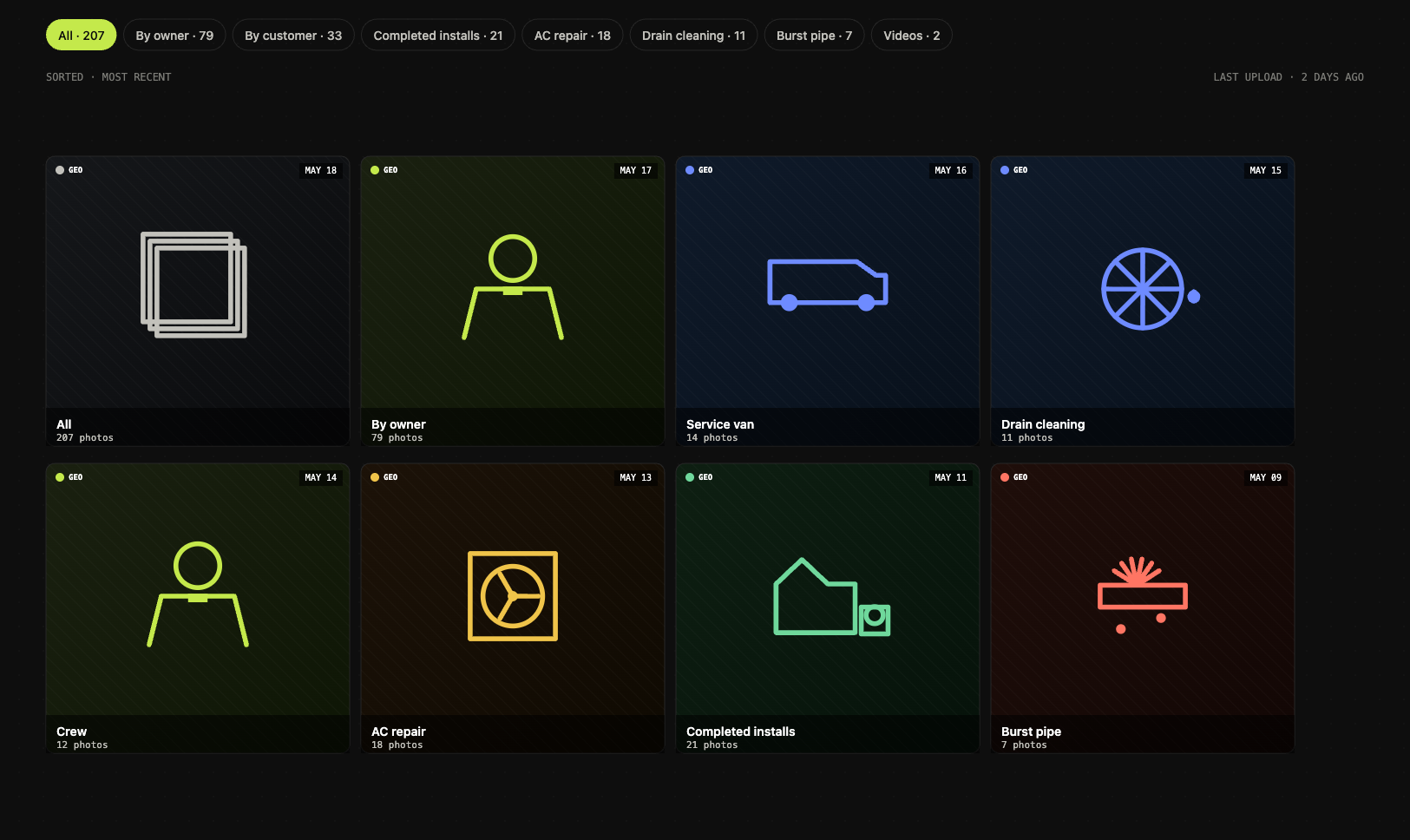
What the local algorithm actually sees.
 1
2
3
4
5
1
2
3
4
5
112 photos in the well · "All"
The volume that does the compounding. Above the local-pack threshold by 4×.
79 owner-uploaded · "By owner"
70% of the gallery is staff-driven — the cadence signal Google reads as "actively in business."
Service-named buckets · "AC repair 18"
Generic albums lose. Each category becomes its own ranking surface for that service.
Outcome proof · "Completed installs 21"
Finished-work shots do the trust work on every comparison tab the homeowner opens.
Niche emergency category · "Burst pipe 7"
Captures urgent, high-intent searches your competitors can't service. Small bucket, high ROI.
The kind of geo-tagged, on-site cadence the local algorithm rewards. Real, dated photos beat polished marketing shots because they're proof you actually worked in the neighborhood.
NAP consistency and citation building
Name, address, and phone number have to match exactly across every directory. Mismatches confuse Google and tank Local Pack rankings. "Smith Plumbing LLC" and "Smith Plumbing" read as two different businesses. Pick one and use it everywhere. Run a citation audit annually with Whitespark, BrightLocal, or Moz Local. Fix mismatches and kill duplicates.
The directories that move the needle for home services break down into three tiers.
Winning the Local Pack — the three signals that matter
Proximity to a searcher matters, but it's not the whole game. Three signals do the heaviest lifting in 2026.
- Review velocity. New reviews in the last 30 days, with text and ideally photos. Four-plus new reviews per week signals to Google a business is alive and busy.
- Category relevance. Your primary GBP category matching the searcher's exact query ("Plumber" beats "Home Improvement" for "emergency plumber near me").
- GBP activity. Posts, photos, Q&A responses, and replies to reviews in the last week. A dormant profile loses to an active one with fewer total reviews.
Geo-grid rank tracking
A single ranking position is fiction in local search. The same query can rank #2 from one homeowner's kitchen and #14 from three miles down the road. Local Falcon, BrightLocal, and PlacePuls all run geo-grid scans that show the heat map of where you rank across a city.
That's how you spot the ZIP codes where you're losing and need new content, new citations, or new reviews from customers in that area. Most contractors track one ranking position. The contractors winning the Map Pack track 49.
Google Ads, LSAs, Performance Max — what's actually working.
Paid search is where the highest-intent home services buyers live. A homeowner typing "AC not cooling" at 11pm is closer to handing over a credit card than anyone who'll see your Facebook video this week. The catch in 2026 is that the auction has gotten more expensive across every trade, and the gap between contractors who run paid well and contractors who burn money on it has widened.
LSAs in 2026 and the Google Verified badge
Google Local Services Ads sit at the top of the search results, charge per qualified lead instead of per click, and put a green Google Verified badge on your listing once you pass background checks and insurance verification. In October 2025, Google consolidated the old Google Guaranteed and Screened badges into a single Google Verified mark for most home services categories.
LSAs are the easiest paid product for a small contractor to run, and they're capped by ZIP-code demand — so getting in early in a market matters. The contractors who dispute bad leads consistently see their cost per qualified lead drop 15 to 25% over a quarter, because Google reads disputes as a quality signal and routes better leads toward listings that flag the bad ones. Most contractors dispute nothing. That's free money on the table.
2026 cost-per-lead, by ad type
Home services averages across Salty's-managed accounts
CPL alone is the wrong metric. A $300 lead from a seven-step qualification form will outperform three $100 leads from a name-and-email form, every time.
2026 benchmarks by trade
The headline CPL is wrong on its own — ROAS is the golden metric — but the by-trade ranges below give a sober starting line. A $300 lead from a seven-step qualification form will outperform three $100 leads from a name-and-email form, every time.
Search and Performance Max — when to use each
Search Ads still win the high-intent keyword the homeowner actually types. Call-only campaigns are good for emergency trades like plumbing and HVAC. Branded search defends your own company name — the cheapest, highest-ROAS inventory you'll ever buy. Your competitors are bidding on your brand. Don't overlook it.
Performance Max should come third, once an account has 30+ conversions a month and clean conversion data flowing in from call tracking and CRM. Feed PMax form fills and it finds you the cheapest forms, which usually means the worst leads. Feed it booked appointments and revenue, and it finds bigger jobs.
LSAs vs. Search Ads vs. PMax — when to use each
| Local Services Ads | Search Ads | Performance Max | |
|---|---|---|---|
| Cost model | Per qualified lead | Per click | Per conversion |
| Intent | High calls + booked appts | High active searchers | Mixed |
| Best for | Emergency, repair, residential | Replacement, project, branded | Scaling once conversion data is clean |
| Quality control | High disputable leads | Medium negatives needed | Low algorithm runs the show |
| Scalability | Capped by ZIP demand | High | Highest |
| Setup difficulty | Low | Medium | Med–High |
The five reasons home services PPC fails
The same handful of mistakes show up in nearly every home services account we audit:
- No negative keyword list, so the account spends on "plumber jobs hiring near me," "free HVAC tune-up," and "DIY drain cleaning."
- Smart Bidding optimizing toward Form Fills instead of qualified leads — training the algorithm to find the cheapest forms (read: the worst leads).
- Landing pages that send paid traffic to the homepage instead of a campaign-specific page for the exact service and city.
- No call tracking, so half the conversions never get attributed and the bidding algorithm flies blind.
- Geo-targeting at the metro level instead of ZIP, so budget bleeds on calls from outside your service radius.
Fix those five and the same budget produces 30–60% more booked jobs. We've seen it on enough audits to call it a pattern.
When Meta beats Google — if the offer is right.
Meta CPMs jumped roughly 20% year over year in 2025, and a lot of contractors wrote the channel off because the leads "got worse." The leads didn't get worse, but the same budget reached fewer homeowners. Meta still works in 2026 when the offer matches the moment: a low-commitment inspection or repair offer, creative that surfaces a monthly payment, and aggressive remarketing of website visitors.
Google catches the homeowner who already knows they have a problem. Meta catches the homeowner who hasn't gotten there yet. Generic "free quote" creative competing for 2022 buyers at 2026 CPMs is the losing trade.
The contractors thriving on Meta in 2026 share three things:
- They lead with a low-commitment offer (an inspection, not a quote).
- They use visual-first creative — real before-and-after, real techs, real trucks.
- They remarket aggressively to anyone who hit the site or watched 50% of a video.
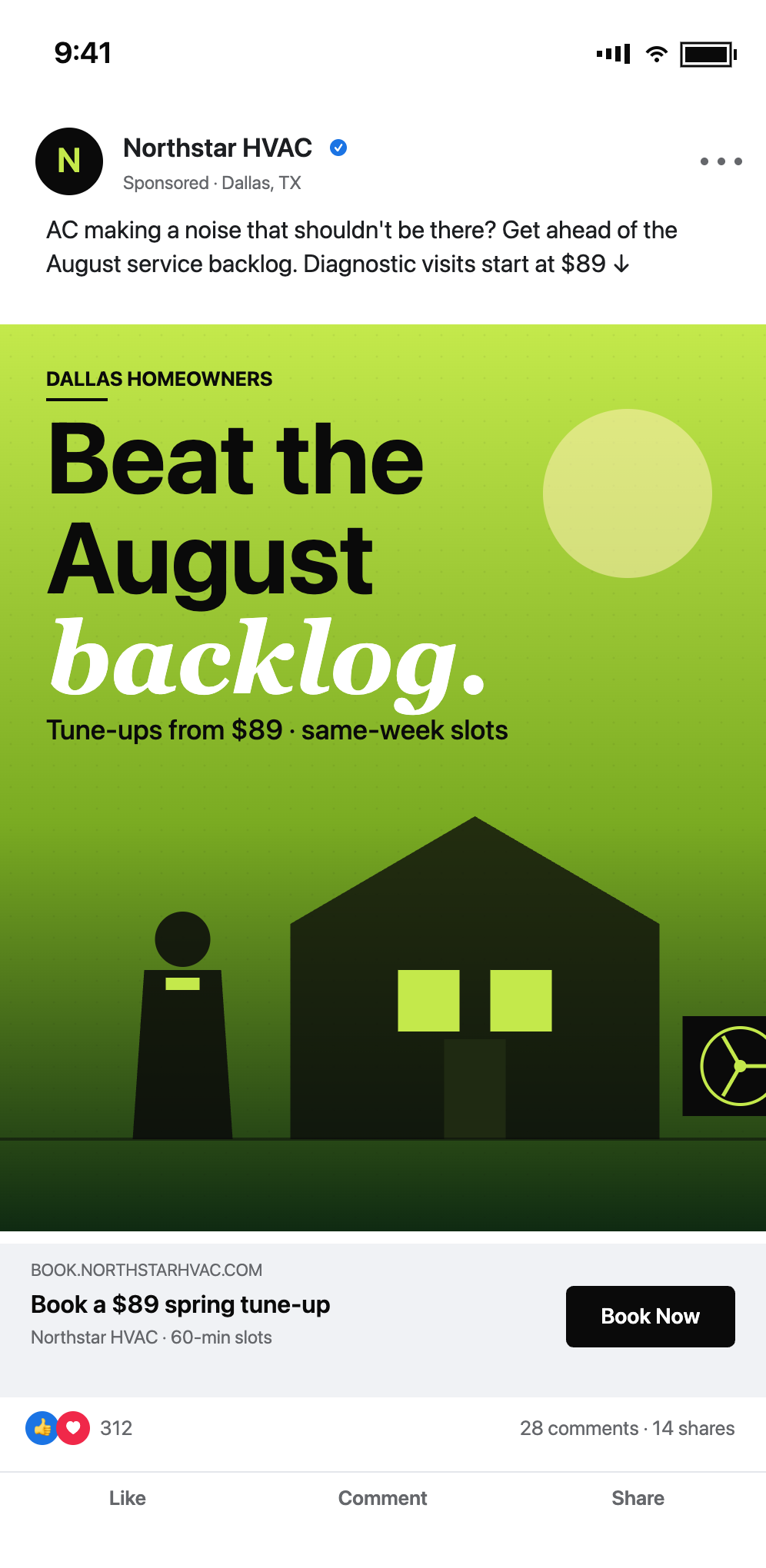
-
01
Geo-locked hook
DALLAS HOMEOWNERS qualifies in the first line. Anyone outside the geo scrolls past — the click that doesn't fire was free to skip.
-
02
Repair-first, not replacement
AC blowing warm, weird noises, or a high bill meets the cautious 2026 buyer earlier in the journey. Replacement asks for a $12K decision; repair asks for a phone call.
-
03
Urgency without discount
Beat the August service backlog pulls timing without burning margin on a 20% off offer. Discounting a decision they haven't made doesn't move them.
-
04
Branded proof, in motion
Real tech on a real install, branded van with the URL on the side. Static or motion both work — the angle is what matters.
-
05
Book-flow CTA, not "Learn more"
Book a tune-up → book.northstarhvac.com → multi-step form. Pre-qualifies before the sales call instead of dumping into a generic homepage.
Reviews, reputation, and the five-minute rule.
Two unpaid assets do more for home services close rates than any single ad campaign — a healthy review profile and a follow-up system that catches every lead within five minutes. Do not write these off as "soft" work. They're the multiplier on every dollar above them.
Reviews as a ranking signal — and an AI citation signal
The homeowner who clicks your Google ad doesn't go straight to your website. They open a second tab and check your reviews. If you sit at 4.2 stars with 27 reviews and the contractor below you sits at 4.8 with 230, you just paid for the click and handed the lead to your competitor.
Google's Local Pack algorithm weighs review count, review recency, average star rating, and review text relevance. A dormant 5-star profile with 50 reviews from 2022 loses to an active 4.7 with 30 from the last 90 days.
AI search reads the same signals from a different angle. ChatGPT, Perplexity, and Google AI Overviews pull review snippets and aggregate ratings into their answers when a homeowner asks "best plumber in Dallas" or "is [your business] any good." High review volume, recent activity, and named locations inside the review text all make a contractor more citable in AI answers.
How to ask — the moment, the channel, the script
Ask every customer at the moment of payment, when they're happiest, with a tablet in hand and a QR code linked straight to your Google review form. Automate the same ask over SMS through Jobber, Housecall Pro, ServiceTitan, Birdeye, or Podium an hour after job completion. Train every tech on a one-line script: “If we did right by you today, the biggest favor you can do is leave us a quick Google review. I'll text you the link before I leave.”
Hey [first name], it's [tech] from [company].

Thanks for trusting us with the [service] today.
If we did good work, would you leave us a quick
Google review? Takes about 30 seconds:

[link]
Responding to every review
Reply to every positive review with the customer's name, the job, and a thanks that doesn't read like a template. Reply to every negative review within 24 hours, owning what's yours, offering a phone number, and never arguing in public. Don't run review-gating software — Google catches it, and homeowners have caught on too.
Schema markup for reviews
Mark up your homepage and service pages with LocalBusiness schema including aggregateRating (rating value and review count) and individual Review snippets where you have permission. Schema makes the star rating eligible for rich results in organic search and feeds the structured data LLMs prefer when pulling citations.
The speed-to-lead clock
The MIT / InsideSales study is the most cited piece of research in lead gen — and most home services operators still ignore it.
An after-hours plan that books appointments
A lot of home services leads come in outside business hours — forms filled at 9pm Friday, 7am Saturday, lunch on Wednesday. If your sales team starts calling those at 8am Monday, you've lost two-thirds of them.
A workable after-hours stack:
- Auto-text within 60 seconds of any form submission. "Hi [name], this is Mike at [company]. Got your request. I'll call you within the hour. If urgent, text me back here." A real cell number, a real name.
- Live answering service for inbound phone calls (Smith.ai, Ruby, Nexa). They answer 24/7 in your company name, capture the lead, and book appointments to your calendar.
- AI receptionist for high-volume operators — CallRail Voice Assist, ServiceTitan's, Jobber's, Goodcall, Numa. Full call answering without per-minute service costs.
- A 9am Monday callback rule for everything that came in over the weekend, with the answering service or auto-text holding the lead together until the human follows up.
The 9:43 PM Friday form-fill that doesn't sleep.
Hi Sarah, this is Mike at Coastal HVAC.
Got your request — AC blowing warm in the upstairs bedrooms. I'll call you within the hour. If urgent, text me back here.
yes urgent — it's already 88° in here and we have a baby. tomorrow morning ok?
Booked you for Saturday 10am. Calendar invite sent to sarah@…
I'll have a portable unit on the truck for the bedroom in case we can't get parts same-day.
Form submitted
Sarah, Dallas. Upstairs AC blowing warm, two-story Colonial, infant at home.
Auto-text fires
Real cell, real name. CRM-triggered. Industry average to first contact: 47 hours.
Homeowner replies
Confirms urgency. Two competitors haven't responded yet.
Saturday 10 AM on the calendar
Total time from form to confirmed appointment: 4 minutes.
A real cell number, a real name, and a 60-second SLA. The single highest-ROI automation in home services — and the reason the 9 PM Friday form-fill doesn't end up in Monday's voicemail.
Content and video that ranks on Google and in LLMs.
Content that wins in 2026 answers specific homeowner questions in the same language the homeowner uses, with structure clean enough for Google's algorithm and AI search to lift directly. The homeowner who used to type "best HVAC company in Tampa" into Google now asks ChatGPT or Perplexity the same question, and gets a single answer with three or four named businesses. If your business isn't one of those names, you're essentially invisible.
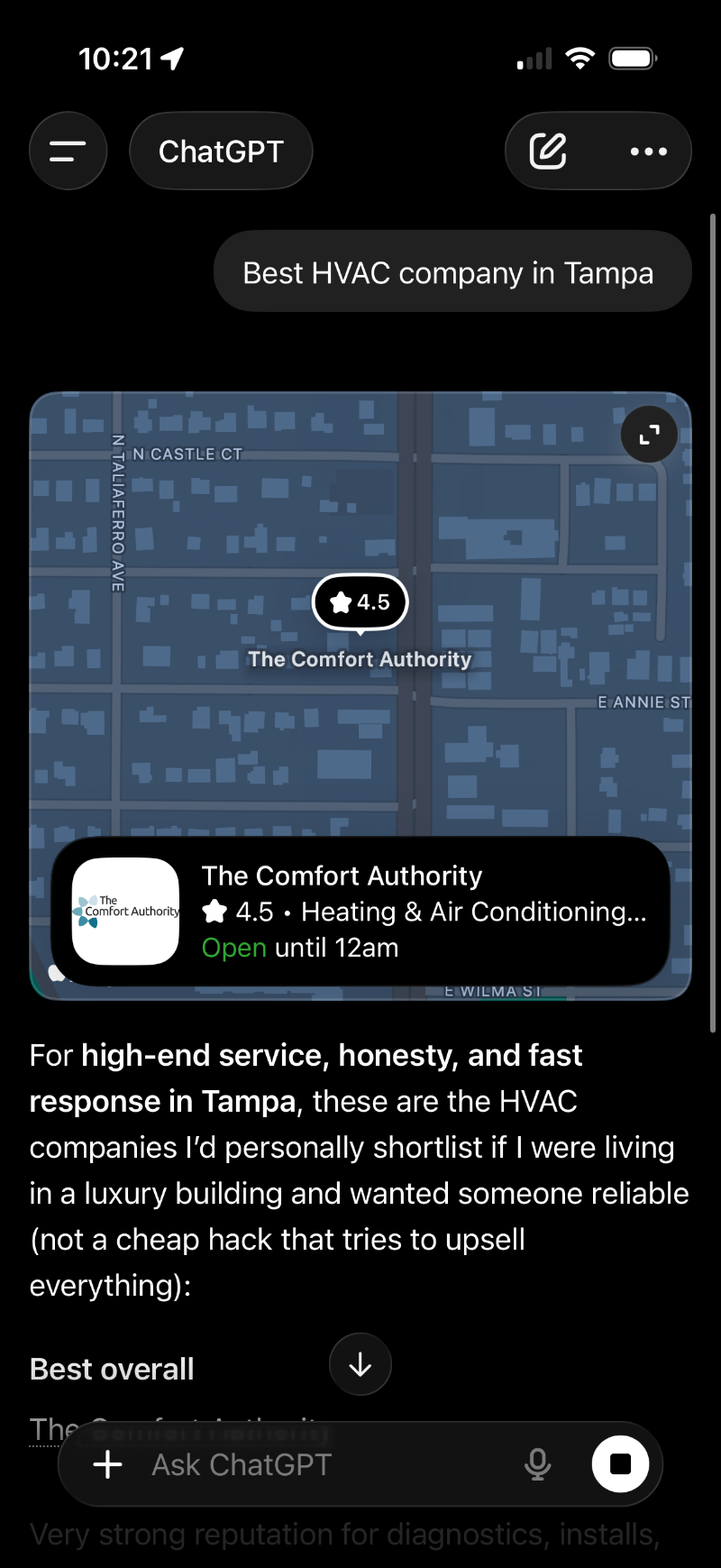
One question. One name. No second tab.
A homeowner asks ChatGPT for the best HVAC company in their city, and gets a single business with a map widget, a star rating, and a sentence of editorial reasoning. There is no #2, #3, #4 in the same eyeshot. The fourth listing doesn't exist — and neither, increasingly, does the second.
Topic clusters built around homeowner pain points
A pillar page plus six to ten supporting articles, all interlinked, beats one long page sitting alone. Build clusters around the questions homeowners actually type into Google: cost, repair-or-replace, seasonal headaches, brand comparisons, warranty. The internal links pass authority between pages, and the cluster signals topical depth to both Google and LLMs.
Example cluster — pest control
Pillar + 6 supporting articlesPest Control Services in [City]
How much does pest control cost in 2026?
CommercialQuarterly vs. monthly pest control: which is right for your home?
CommercialTermite warning signs every homeowner should know
InformationalAre pest control chemicals safe for pets and kids?
InformationalHow to prepare your home for pest control treatment
InformationalPest control vs. DIY: when to call a professional
CommercialPricing pages are the 2026 gap
"How much does a new HVAC system cost" gets more searches every month than the equivalent feature query. Yet most home services companies are nervous to publish any sort of pricing because they're afraid of scaring leads off. The homeowner is going to find a number somewhere. They'd rather find it on your site, with context, than on a forum post from 2019. A pricing page with honest ranges, the variables that move the number, and a financing widget showing the monthly payment converts a high-intent visitor way more than a generic service page.
YouTube for contractors
YouTube is the single most-cited domain in Google AI Overviews. It's also where the homeowner researching a $20,000 decision goes after they've read three articles. Three video formats work for home services contractors:
Job walk-throughs. A 4-minute breakdown of a real install or repair, narrated by the owner or lead tech.
Educational explainers. The question homeowners ask before they call, answered on camera.
Crew and company videos. Faces, trucks, real jobs — the trust photos can't build alone.
Title each video with the exact question a homeowner would type. YouTube auto-captions the video. Separately, put a written version (transcript, summary, or structured set of key takeaways) on the contractor's own page below the embed, so your domain gets the SEO and AI-citation credit — not just YouTube.
FAQ schema, HowTo schema, and answer-first formatting
Open every article, and every section inside it, with a 40–60 word answer to the question, then go deeper from there. That short, direct answer at the top is the chunk LLMs grab and quote. Then add schema markup — the hidden code that labels your content for search engines and AI tools so they know exactly what's on the page. Two types matter most:
- FAQPage schema for any article with three or more questions and answers (like a pricing FAQ or a service explainer).
- HowTo schema for step-by-step guides (finding a roof leak, prepping a yard for landscaping, installing a programmable thermostat).
Both make your pages eligible for rich results in Google and hand ChatGPT, Perplexity, Claude, and Google AI Overviews a clean, structured answer they can lift straight into their responses.
// LocalBusiness + FAQPage schema, condensed
  {
    "@context": "https://schema.org",
    "@graph": [
      {
        "@type": "Plumber",
        "name": "Coastal Plumbing & Drain",
        "address": { "@type": "PostalAddress",
          "addressLocality": "Tampa",
          "addressRegion": "FL" },
        "telephone": "+1-727-555-0184",
        "aggregateRating": { "@type": "AggregateRating",
          "ratingValue": 4.9, "reviewCount": 312 }
      },
      {
        "@type": "FAQPage",
        "mainEntity": [{
          "@type": "Question",
          "name": "How much does a water heater cost in 2026?",
          "acceptedAnswer": { "@type": "Answer",
            "text": "Standard 40–50-gallon tank installs run $1,400–$2,600 in Tampa,…" }
        }]
      }
    ]
  }
How LLMs actually choose sources
LLMs aren't ranking pages exactly like the Google algorithm for SEO. They're extracting answers based on signals. Three signals do most of the work.
- Entity recognition. Does the model know who you are as a business, with structured data backing it up?
- Freshness. Was the content updated recently, with a visible date?
- Extractable structure. Can the model lift a clean 40–60 word answer without reformatting?
Pages that look beautiful to a human but bury the answer in storytelling lose to plainer pages that lead with the answer.
Platform-by-platform tactics
The GEO checklist
The work that gets a home services business cited by LLMs:
Author bios with sameAs schema
Real human, real title, real LinkedIn URL, links out to Crunchbase, Clutch, and any podcast appearances.
Schema stack
LocalBusiness, Service, FAQPage, HowTo at minimum. How LLMs confirm what your business is and what it does.
Answer-first paragraphs (40–60 words)
Per Kevin Indig's analysis of 1.2M ChatGPT citations, 44.2% of all citations come from the first 30% of the text.
Original data, named quotes, year-stamped freshness
Statistics Addition lifts citation visibility by 41% and Quotation Addition by 28% (GEO paper, KDD 2024).
Reddit, YouTube, trade-media presence
Reddit feeds Perplexity. YouTube feeds Google AI Overviews. Contractor Magazine, ACHR News, and Roofing Contractor feed Claude.
llms.txt and IndexNow
A simple llms.txt file at the root of your site summarizing canonical claims on your most important pages. IndexNow speeds up Bing and Copilot ingestion.
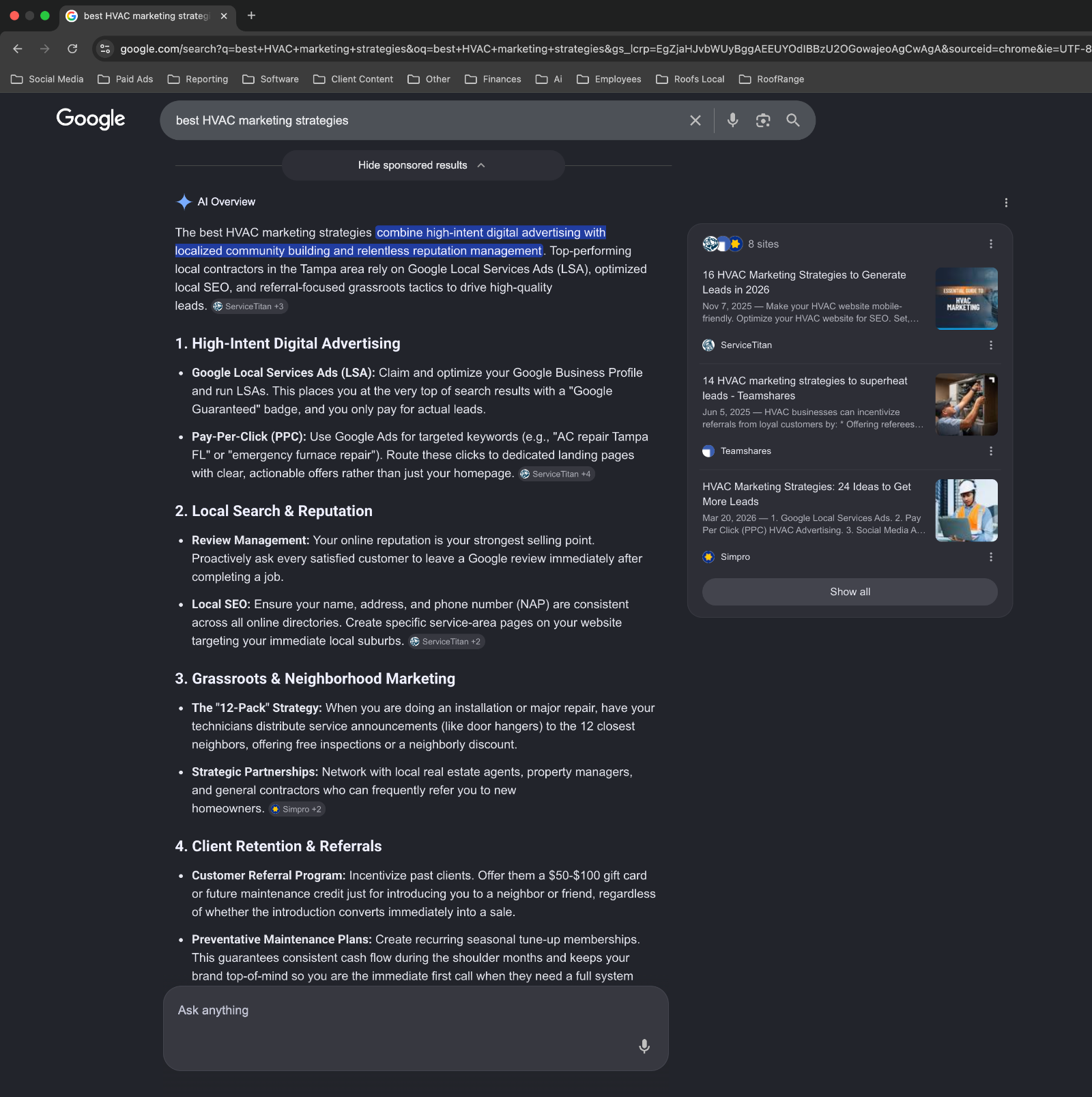
What an AI Overview actually cites in 2026.
 1
2
3
4
1
2
3
4
- "Combine high-intent digital advertising with localized community building and relentless reputation management."
- Exactly the kind of clean, scannable headline answer the model lifts straight from a publisher
- If your page buries the answer in storytelling, the LLM grabs it from a competitor that didn't
- "ServiceTitan +3" means the model found four corroborating sources for that paragraph
- Citation patterns reward depth of agreement across properly-structured publishers, not raw rank
- One vertical-software vendor's blog can carry an entire section if its schema is clean
- Three visible: ServiceTitan, Teamshares, Simpro \u2014 all "X HVAC marketing strategies" listicles
- All software-vendor blogs. All FAQ-friendly listicle format. All updated within the last 12 months.
- This is the lane to compete in: well-structured, named-author, freshly-dated long-form on your own domain
- No Reddit thread in the visible 8. No YouTube video.
- The same query on Perplexity surfaces both \u2014 different platforms, different source biases
- The play is both: publisher-grade structure on your own pages and authentic presence in r/HVAC, YouTube job walk-throughs, and trade media
Eight trades, eight different economics.
Keep in mind these numbers are observed averages. CPL alone doesn't take into account lead quality or how competitive a specific market is. For a more personalized plan, connect with an expert — but the snapshots below are a sober starting line for each trade's economics, channel mix, and recommended monthly spend.
HVAC runs on emergency intent and seasonal swings. The phone rings hardest the first 95° day of summer and the first 25° night of winter, and goes quiet in the shoulder seasons.
The playbook leans on LSAs and call-only Search Ads for emergency capture, with a maintenance plan ($199–$399/yr) that smooths revenue across the off-season. Financing on full system replacements ($8K–$15K tickets) is the biggest 2026 lever.
Plumbing is the closest thing to pure same-day search behavior in home services. A homeowner with water on the floor isn't comparing quotes. They're calling the first business that picks up.
LSAs and call-only Search do the heavy lifting. Click-to-call above the fold, an answering service for after-hours, and a 24/7 promise on the GBP move the needle more than any creative work. Water heater campaigns run higher at $256/lead.
A project sale with a 30–90 day decision window, and the 2026 buyer mix has shifted from insurance-funded storm work toward self-financed replacement after a quiet 2025 hurricane season.
Wins on financing-led offers ("$189/month, $0 down"), repair-first creative that meets the cautious buyer earlier, and a 5-minute speed-to-lead system to win the multi-quote shopper.
Buyers split between safety emergencies (sparking panel, half the house without power) and project work (EV charger installs, panel upgrades for solar, whole-home generators).
The compounding play is service-agreement programs ($149–$249/yr). EV charger and generator content is the highest-growth keyword cluster going into 2026.
A visual-first trade. Instagram and Pinterest do more for top-of-funnel awareness than Google Ads. Buyer mix splits between project work (paver patios, retaining walls, new lawn) and recurring contracts (weekly mowing, biweekly maintenance, seasonal cleanups).
The recurring contract is where the compounding happens. A residential mowing customer at $180/mo over an 8-month season is worth $1,440/yr and refers neighbors. Local SEO and geo-tagged before-and-afters on GBP outpace paid search for most landscapers under $1M.
The cleanest recurring-revenue model in home services. A quarterly contract at $89–$129/visit puts a single customer at $400–$500/yr with low cancellation if service is consistent.
LTV changes the marketing math — a pest-control business can spend more to acquire than a one-off plumbing call, because LTV is higher and more predictable. Heavy investment in Google Ads, LSAs, and Nextdoor pays back; referral and email retention are the highest-LTV channels.
High-ticket, low-frequency. Average homeowners replace a door once every 15–20 years, but emergency repair (broken spring, off-track, opener failure) drives the steady-state lead flow.
The Garage Door Marketers report recommends ~60% of paid media to LSAs given that 29% of consumers prefer clicking LSAs versus 11% for traditional PPC. Replacement-door sales benefit from strong visual content and financing offers.
Highest conversion rate in home services — 17.65% on Google Ads (LocaliQ 2025). Buyers convert fast because the offer is low-commitment ($150–$250 first clean) and the decision is recurring, not capital.
The compounding play is the subscription. A biweekly cleaning customer at $180/visit is worth $4,680/yr. Referral programs and Nextdoor punch above their weight — the buying decision is heavily neighbor-influenced.
Trade comparison at a glance
| Trade | Search CPL (non-branded) | LSA CPL | Avg ticket | Primary recurring play |
|---|---|---|---|---|
| HVAC | $149 | $51 | $2,110 | Maintenance plans |
| Plumbing | $183 | $57 | $1,714 | Service agreements |
| Roofing | $124 | $25–$80 | $10K–$12K | Maintenance plans |
| Electrical | $128 / $93.69 | $39–$60 | $400–$2,500 | Annual service contracts |
| Landscaping | $85 | n/a | $180/visit | Mowing & maintenance contracts |
| Pest Control | $40–$60 | $20–$30 | $89–$129/visit | Quarterly contracts |
| Garage Doors | $35–$85 | $25–$45 | $150–$4,500 | Repair→replacement cycle |
| Cleaning | $46.99 | n/a | $150–$250 / $180 rec. | Bi-weekly subscriptions |
Sources: SearchLight Digital Q1 2026 benchmarks (HVAC, plumbing, roofing, electrical) · LocaliQ 2025 Home Services Search Ad Benchmarks · EverGrow Marketing 2025 Landscaping Benchmark · Cube Creative 2026 Pest Control Advertising Guide · Bear North Digital 2026 Garage Door Guide · Garage Door Marketers 2025 Industry Report · Salty's account data.
The home services tech stack.
The marketing only works if the tech behind it captures every lead, attributes it correctly, and feeds clean data back into your ads. Four categories do the heavy lifting.
Field service software
Holds the customer list for email and SMS, fires the automated review request after every job, runs the referral program, and feeds job revenue back to Google Ads so Smart Bidding optimizes for booked revenue — not cheap form fills.
Call tracking
Catches the half of home services leads that still come in by phone. Without it, the bidding algorithm is flying blind. Records, transcribes, and tags every call back to the campaign that drove it.
Reputation tools
Automate review requests by SMS, pull reviews live onto the site, and monitor responses across Google, Facebook, Yelp, and BBB in one dashboard. The piece most contractors hand-roll — and the piece that compounds slowest if you do.
Attribution & CRM loop
GA4 plus UTM tagging plus CRM closed-loop. Tags every campaign source on the front end and pushes every booked job back into Google Ads on the back end. The single highest-leverage piece of plumbing in 2026.
Past customers cost a fraction of a cold lead and close 3 to 5× more often. A simple seasonal cadence keeps you in front of them at the exact moment they need you.
Seasonal cadence — email and SMS
- January · HVAC tune-up reminders, "schedule before spring rates rise"
- March · Gutter cleaning, roof inspections, pre-summer AC service
- June · Pest control booster, irrigation check, exterior cleaning
- September · Heating tune-up, chimney inspection, fall gutter cleaning
- November · Holiday lighting install, plumbing winterization
- All year · Birthday discounts, anniversary check-ins, post-job follow-up at 30 and 365 days
KPIs — measuring the right things.
Most home services dashboards measure the wrong things. Impressions, clicks, and form fills tell you the campaign is alive. They don't tell you whether it's making money.
A $40 lead that never books costs you more than a $200 lead that closes. Cost per booked appointment is the real number. Push every form fill and phone call into your CRM with a campaign source attached, and tag the ones that actually got on the calendar.
The funnel — where the leak usually is
Lead → Appointment
Appointment → Bid (sit)
Bid → Close
ROAS, LTV, and attribution
Track ROAS per channel, not in aggregate. A $40,000/month spend at a 4× blended ROAS hides that LSAs are running at 8× and Performance Max is at 1.5×. Rebalance accordingly.
Lifetime value matters more in home services than most contractors realize. A residential customer who buys a new HVAC system, signs up for a maintenance plan, and refers two neighbors is worth multiples of the first-job revenue over a decade. Bid your ad spend against LTV, not first-job revenue.
Roughly half of home services leads still come in by phone. If you don't have call tracking (CallRail, WhatConverts, CallTrackingMetrics), you don't know what's working. Pair call tracking with GCLID capture and offline conversion uploads. Smart Bidding optimizes toward whatever you feed it. Feed it real revenue and it finds bigger jobs.
How to choose a home services marketing agency.
A lot of contractors hire an agency on a referral and a 30-minute call, then spend the next six months trying to figure out what they're paying for. A short list of questions up front saves the headache:
- How many home services clients do you currently work with in my trade?
- How do you define a qualified lead, and what metric do you optimize for?
- Can I see a search-term report or landing page from a current client in my vertical?
- What's the contract length, and what's the offboarding process?
The bigger filter is what you're paying for. Impressions, clicks, and form fills are easy to report and easy to inflate. Booked appointments and signed contracts are harder to fake.